Karting looks dangerous and is, mildly. The honest answer to is go karting safe is that it carries a real but small risk, most of it concentrated in a handful of behaviours that are entirely within the driver’s control. The equipment does its job. The track does its job. Most incidents come from someone ignoring a rule they were told about in the briefing.
Here is what actually protects you on an outdoor circuit, where the injuries tend to happen, and what to check before you pull away.
Is go karting safe? What the risk actually is
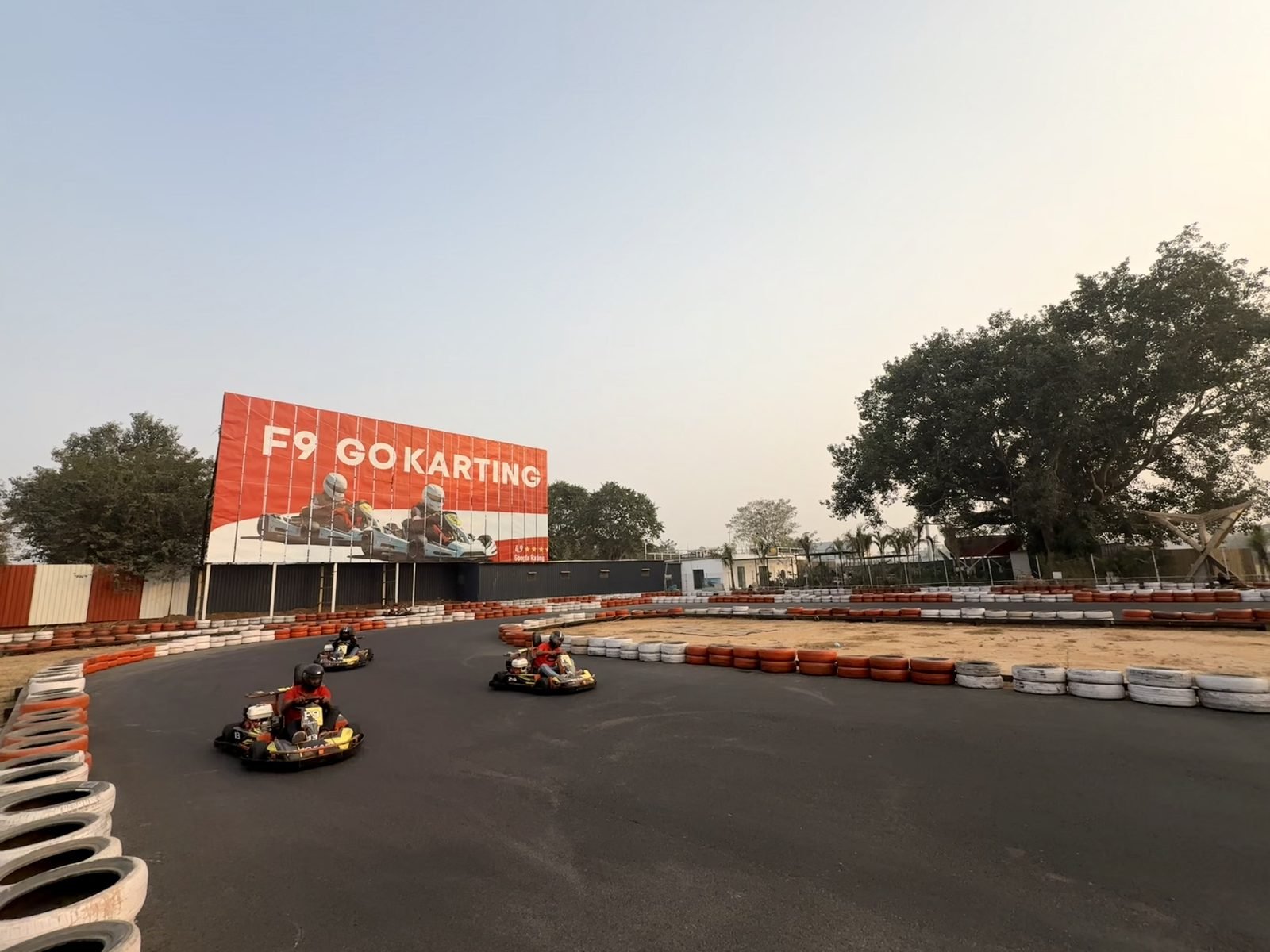
A rental kart on an outdoor circuit is a low-speed vehicle with a wide track, a low centre of gravity and no suspension to speak of. It does not roll easily and it does not reach speeds where a spin becomes a crash. The typical incident is a bump from behind, a spin into a barrier at modest speed, or a bruise from the steering wheel when a driver hits something with their hands still on the rim.
That profile is why karting is generally considered a low-risk activity rather than an extreme one. It is also why the injuries that do happen tend to be minor: bruises, a jarred wrist, occasionally a sore neck the next day.
What protects you, piece by piece
- The helmet. Full-face, with a visor, sized to your head rather than borrowed loose. A helmet that moves independently of your head is worse than useless because it blocks your vision on the side you are turning towards.
- The balaclava or hairnet. Hygiene first, fit second. Both matter.
- Closed shoes. Flat soles. A slider will not give you a clean brake pedal and will not stay on in a hurry.
- The seat and harness. You should be able to reach the pedals with a slight bend in the knee and be held firmly enough that your body does not slide in a corner.
- Side pods and the wrap-around bumper. These absorb the contact that happens in a busy session, which is the most common contact there is.
Barriers and run-off on an outdoor circuit
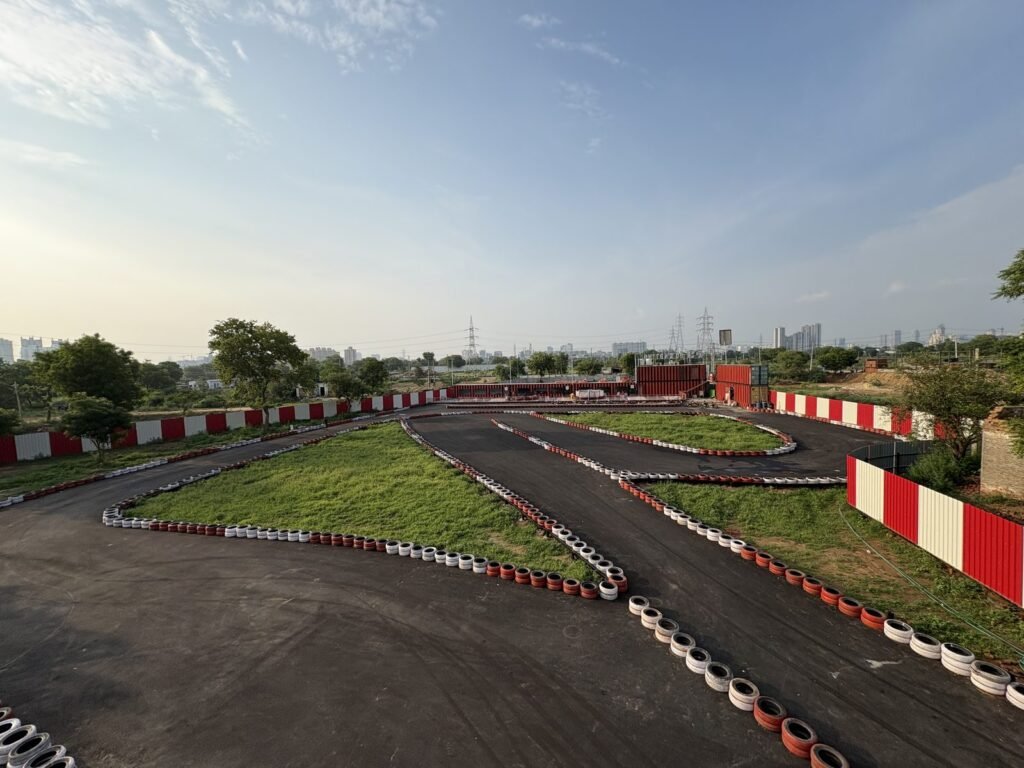
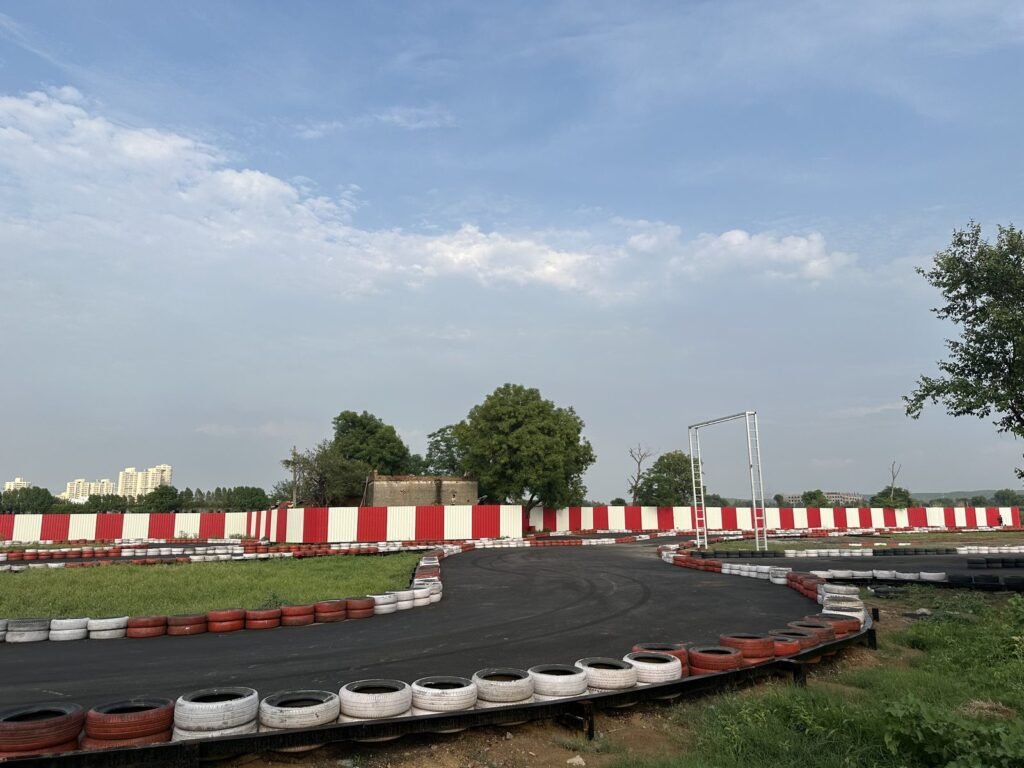
Outdoor circuits have something indoor tracks cannot offer: space. Run-off areas give a spinning kart somewhere to go that is not a wall, and barriers are set back from the racing line rather than right at its edge. Tyre walls and steel barriers are there to stop a kart that has already left the track, not to be touched during normal driving.
That is the structural difference between the two formats. An indoor circuit is bounded by walls a few metres from the line, so a mistake has less room to resolve itself. An outdoor circuit gives the mistake somewhere to end.
Where injuries actually happen
Four patterns cover most of it.
- Contact from behind. A driver who is looking at the kart in front rather than at the corner ahead arrives too fast and uses the leading kart as a brake. This is why no-contact rules exist and why they are enforced.
- Hands outside the kart. A hand out to wave, brace or point is a hand that meets a barrier. Keep both on the wheel until the session ends.
- Standing up after a spin. The instinct after a spin is to get out and push. The correct move is to stay in the seat, hands on the wheel, and wait for a marshal, because the next kart is still arriving.
- Loose objects. A phone in a pocket becomes a projectile in a spin. So do keys and a loose watch.
The rules that do most of the work
Every circuit briefs the same handful of rules, and they exist because they are the ones that prevent incidents rather than merely assigning blame.
- No deliberate contact. A bump is a mistake. A punt is a decision, and it is the decision that causes most injuries.
- No blocking. Moving across the track to defend a position causes more contact than any other single behaviour.
- Slow down under a yellow flag. A yellow means something is on the track ahead of you, not that the race is paused.
- Leave space at the first corner. Most first-lap incidents are a cold-tyre, cold-driver problem at exactly the point where everyone arrives together.
Flags you will see, and what they mean
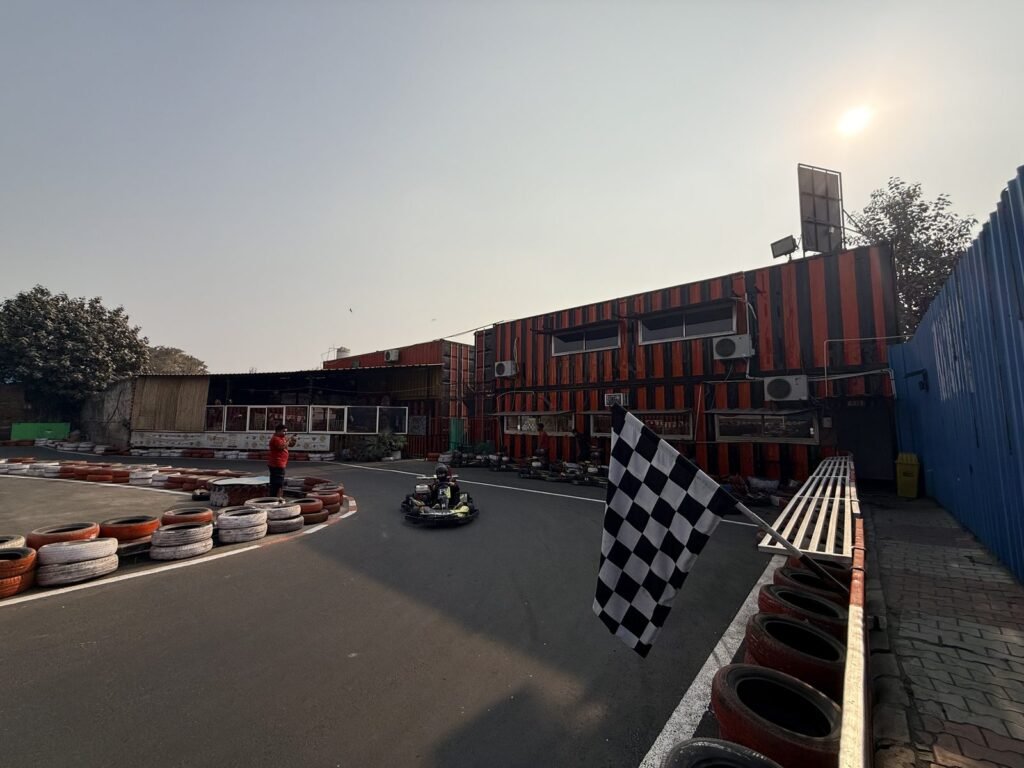
Yellow means slow and prepare to stop. Red means the session is over and you stop where you are told. Blue means a faster kart is behind you and you should hold your line rather than move aside. Chequered means the session has ended and you complete the lap at a reduced pace. The full set is worth reading once before your first visit, and the flags guide covers every signal a marshal can give.
Six checks before you pull away
- Helmet fit. Push the front of the helmet down with one hand. If it rotates over your eyes, ask for a different size.
- Pedal reach. Press the brake fully. Your knee should still be bent.
- Seat position. Close enough that your arms are not straight when the wheel is at full lock.
- Harness or belt. Pull it tight against your hips, not your stomach.
- Loose items. Nothing in pockets and nothing around the wrists or neck.
- The briefing. Listen to the flag explanation even if you have driven before, because circuits differ in what they use.
Is karting safe for children and first-timers
Karting is one of the few motorsports where a beginner can drive on the same track as an experienced driver, because the karts are governed and the speeds are modest. The limiting factors are height and reach rather than age: a driver has to be able to press the pedals and see over the wheel with the seat in its furthest-forward position.
The rule differs by circuit and by kart, so confirm the current minimum age and height with the booking line for the track you are visiting rather than assuming. For a young driver, the first session should be short and supervised rather than a full thirty minutes.
For an adult first-timer, the risk is not the kart but the other drivers. Book a quieter slot where possible, and leave a gap at the start rather than joining the pack into the first corner.
Rain, heat and other conditions
All six F9 circuits are outdoors, so weather is part of the safety picture rather than a footnote. Wet tarmac reduces grip, which means longer braking distances and earlier mistakes, and a marshal will usually slow a session down when the surface is wet. Ask at the desk before you drive if the rain has just started.
Heat matters more than most people expect. A full-face helmet in an Indian summer is hot, and dehydration makes a driver sloppy in exactly the way that causes incidents. Water before the session, not after it.
What to do if something goes wrong
If you spin, keep your hands on the wheel and stay in the seat. If you stall, raise one hand and wait for a marshal rather than climbing out. If you are hit, complete the lap slowly and report it to the marshal at the end of the session, because contact that is not reported cannot be managed.
If another driver is being dangerous, say so. Every circuit has a marshal whose job is to deal with it, and a driver who is deliberately making contact is usually removed rather than warned twice.
Frequently asked questions
Is go karting safer indoors or outdoors?
Outdoors, generally, because there is more run-off and the barriers sit further from the racing line. Indoors the walls are closer, so the same mistake has less room to resolve itself.
Do you need a licence or experience to drive?
No. Rental karting requires neither. The briefing covers the controls, the flags and the rules, and the first laps are driven at a pace the marshals set.
What should I wear to be safe?
Trousers rather than shorts, a top that covers the arms, and closed shoes with a flat sole. Nothing loose around the neck or wrists, and nothing hard in a pocket.
Is karting safe during pregnancy or with a bad back?
Karting involves vibration and occasional contact, so it is not a sensible choice in either case. The seating area is comfortable and spectators are not charged, so it is easy to attend without driving.
Can you flip a go kart?
It is very rare in a rental kart because the centre of gravity is low and the track is wide. Where it does happen, it is almost always the result of one kart driving over the side pod of another, which is why contact rules are enforced rather than tolerated.
Where to go next
If this is a first visit, the beginner guide covers what happens from arrival to the first lap. The tracks page lists all six circuits, and Sector 17/18 is the shortest lap and the gentlest introduction. Send questions through contact, or open the circuit on Google Maps.