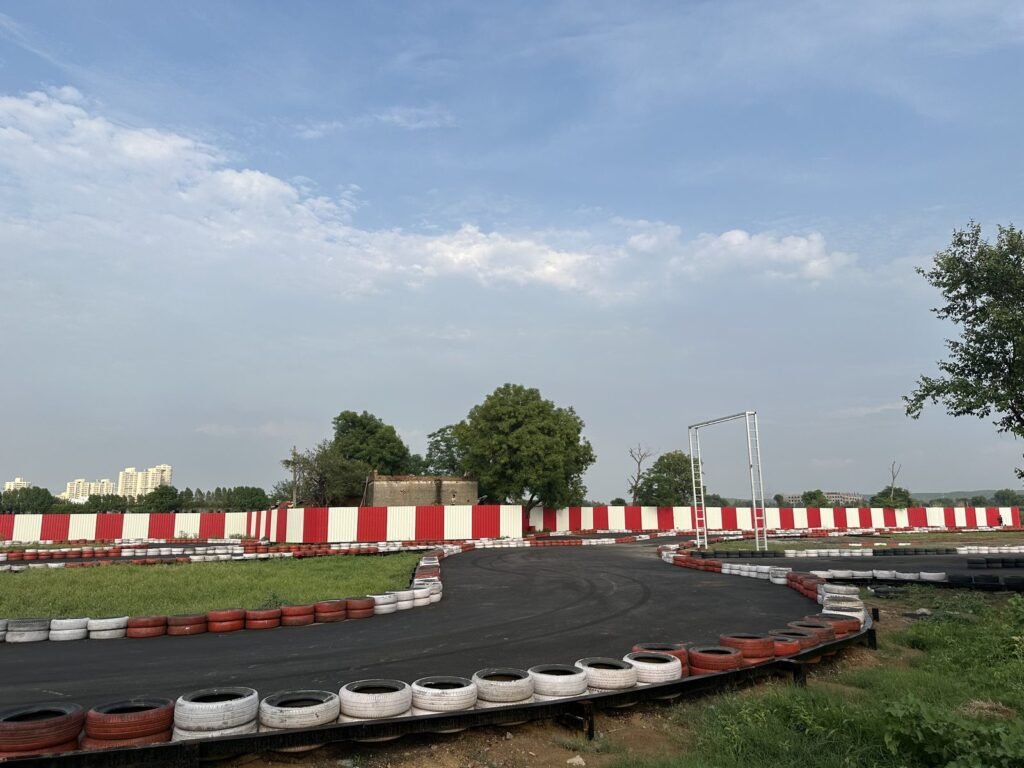
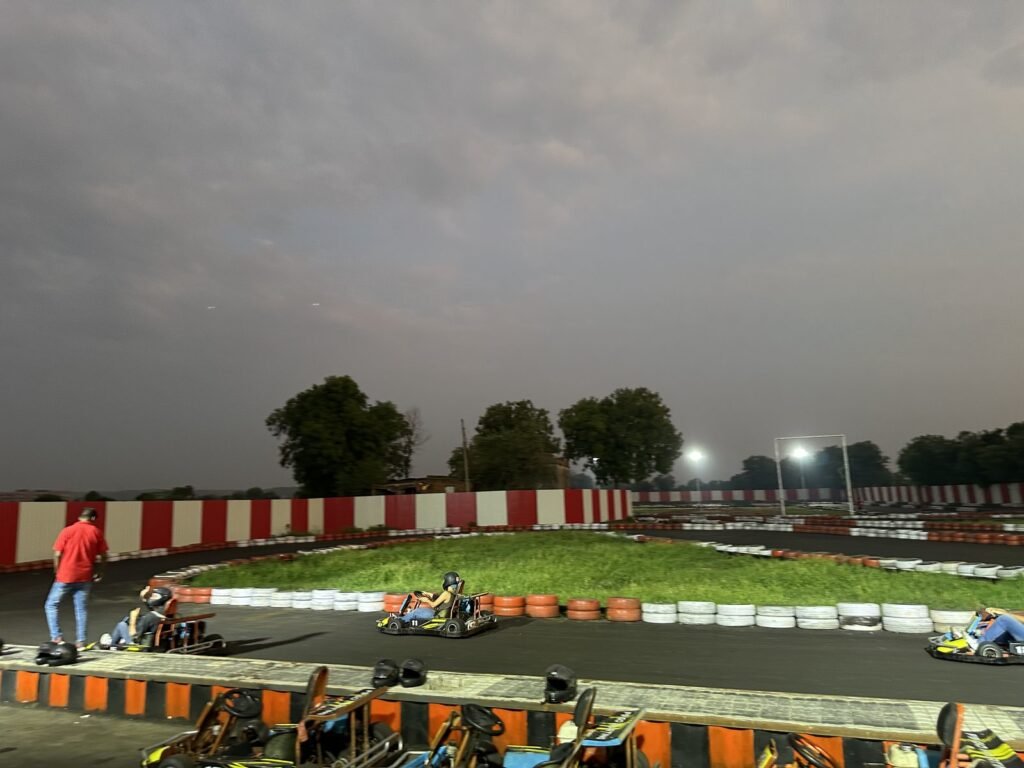
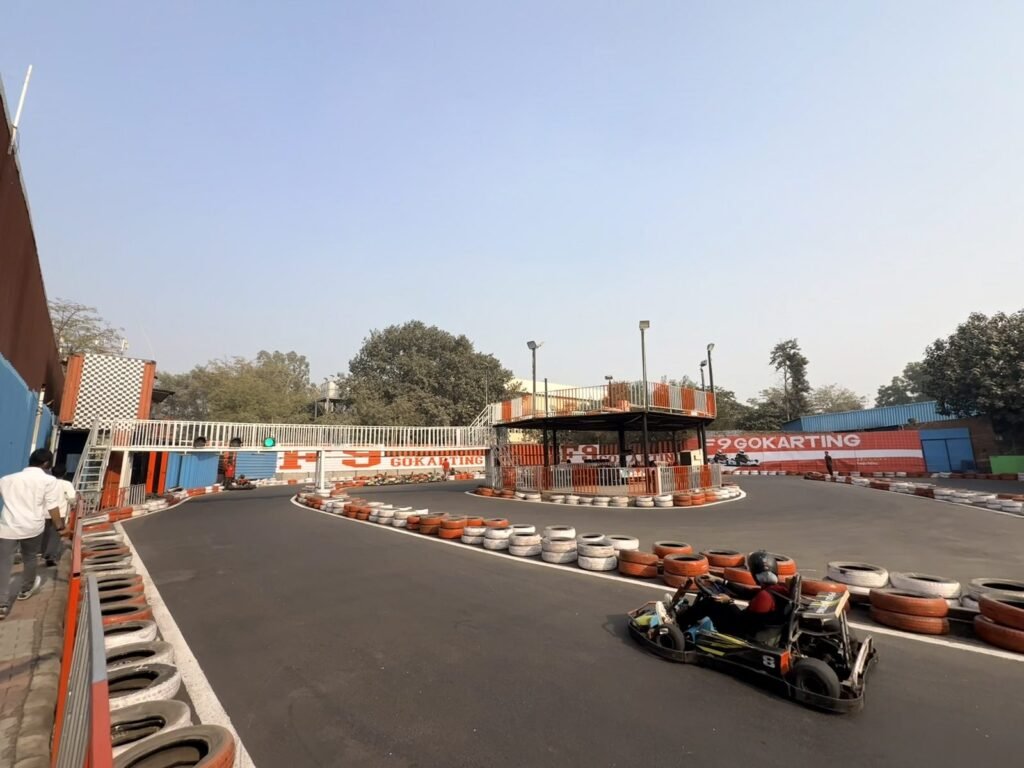
Track length is the first number anyone quotes about a circuit and the least understood. A 450-metre lap and a 1,050-metre lap sound like the same experience at different sizes. They are not. Go karting track length changes how many corners you get per lap, how long a lap takes, how often you catch traffic and how much of a session is spent learning the circuit.
F9 runs circuits at 450, 850, 900, 950 and 1,050 metres, plus a 1,250-metre ground at Baghpat that is hired whole. Comparing the two extremes — the 450-metre lap on Link Road and the 1,050-metre lap at Sector 68 — is the clearest way to understand what the number actually does.
Go karting track length: what the number measures
The figure is the distance around one complete lap, measured along the racing line. It tells you how far you travel per lap, not how long you will be on track. Those two are connected only through your average speed, which is why a kart on a tight 450-metre circuit and a kart on an open 1,050-metre circuit can complete a lap in similar time despite the difference in distance.
What length reliably changes is corners per lap. A short circuit packs its features closer together, so a lap is a rapid sequence of braking, turning and accelerating. A long circuit strings them out, which gives a driver more time to set up each corner and more opportunity to lose speed between them.
The 450-metre lap at Sector 17/18
Link Road is the original F9 circuit and the shortest: 450 metres, minutes from Iffco Chowk. A lap is quick — around forty seconds at a realistic average speed — which means a session contains a lot of laps. In eighteen minutes, a driver can complete twenty laps or more.
That high lap count is the circuit’s real advantage. More laps means more repetitions of the same corner, which is how a beginner actually improves. It also means the group stays close together, so slower drivers are never alone and faster drivers always have someone to chase.
The trade-off is space. On a compact lap there are fewer places to pass and less run-off between corners, so the driving is busy rather than flowing. For a first session that is a feature; for an experienced driver it can feel cramped.
The 1,050-metre lap at Sector 68
Sector 68 is the longest circuit in Gurgaon at 1,050 metres, off Aklimpur Road near Tulip Chowk. A lap takes noticeably longer — roughly seventy seconds at the same kind of average speed — so a thirty-minute session yields about twenty laps in practice, against thirty or more on a short track.
What you buy with that length is rhythm. A long lap lets a driver link corners, carry speed and feel a kart move underneath them. It also spreads the field out, which means less traffic and cleaner laps for anyone who wants to drive quickly.
The cost is time to learn. Three laps on a long circuit is not enough to know which way it goes. The first session on a 1,050-metre lap is partly a sighting run, and the good laps come later. The Sector 68 track page sets out the circuit’s rates and layout.
The arithmetic behind a lap time
A lap is distance divided by speed, plus whatever the corners cost. Take 450 metres at an average of 40 km/h: that is 11.1 metres a second, so the lap takes about 40 seconds. Take 1,050 metres at 50 km/h: 13.9 metres a second, so about 75 seconds.
The interesting part is why the longer track supports a higher average. Fewer corners per hundred metres means less braking and less time spent at low speed. Therefore a long lap is not simply a short lap stretched; it is a lap with a higher proportion of full throttle, which is why drivers describe it as flowing.
This is also why comparing lap times between two F9 circuits is meaningless. A 40-second lap on Link Road and a 75-second lap at Sector 68 are both good laps. Reading them against each other tells you nothing, and the guide to cost per minute makes the same point about price.
The lengths in between
- 450 m — Sector 17/18. Shortest and most central. Highest lap counts, most repetition, best for beginners.
- 850 m — Sector 59. The group venue, up to twenty karts, and the only circuit running sixty-minute sessions.
- 900 m — Dwarka Expressway. A mid-length lap serving the western corridor at Sector 88B.
- 950 m — GT Karnal Road. The long-drive circuit at Bhigan, near Ganaur, on the way back from Murthal.
- 1,050 m — Sector 68. The longest in Gurgaon and the one to book once you have driven before.
- 1,250 m — Baghpat. The largest ground in the network, available for private hire rather than walk-in sessions.
The spread is deliberate. Six circuits with the same length would be one circuit in six places; the differences are what make choosing worthwhile. The six-circuit comparison sets out each one against the others, and the longest track guide takes the 1,050-metre lap apart in more detail.
Which length suits which group
For a first-timer, choose short. High lap counts build confidence quickly, and eighteen minutes on Link Road feels like a proper session rather than a tutorial. For a family with children, the same logic applies: more laps, more smiles, less time spent lost.
For a group of friends who have driven before, choose long. Sector 68 rewards a driver who can carry speed, and the extra distance gives the faster members of the group room to get away. For an office evening, the length matters less than the grid size: Sector 59 takes twenty karts and runs hour-long blocks, which is why it is the usual group choice.
For a photo or a milestone, choose the one with the setting. The long-drive circuits at GT Karnal Road and Dwarka Expressway photograph differently from the city tracks, because the skyline is further away. That is a real reason to pick one over another, even if it is not a driving reason.
A note on length and price
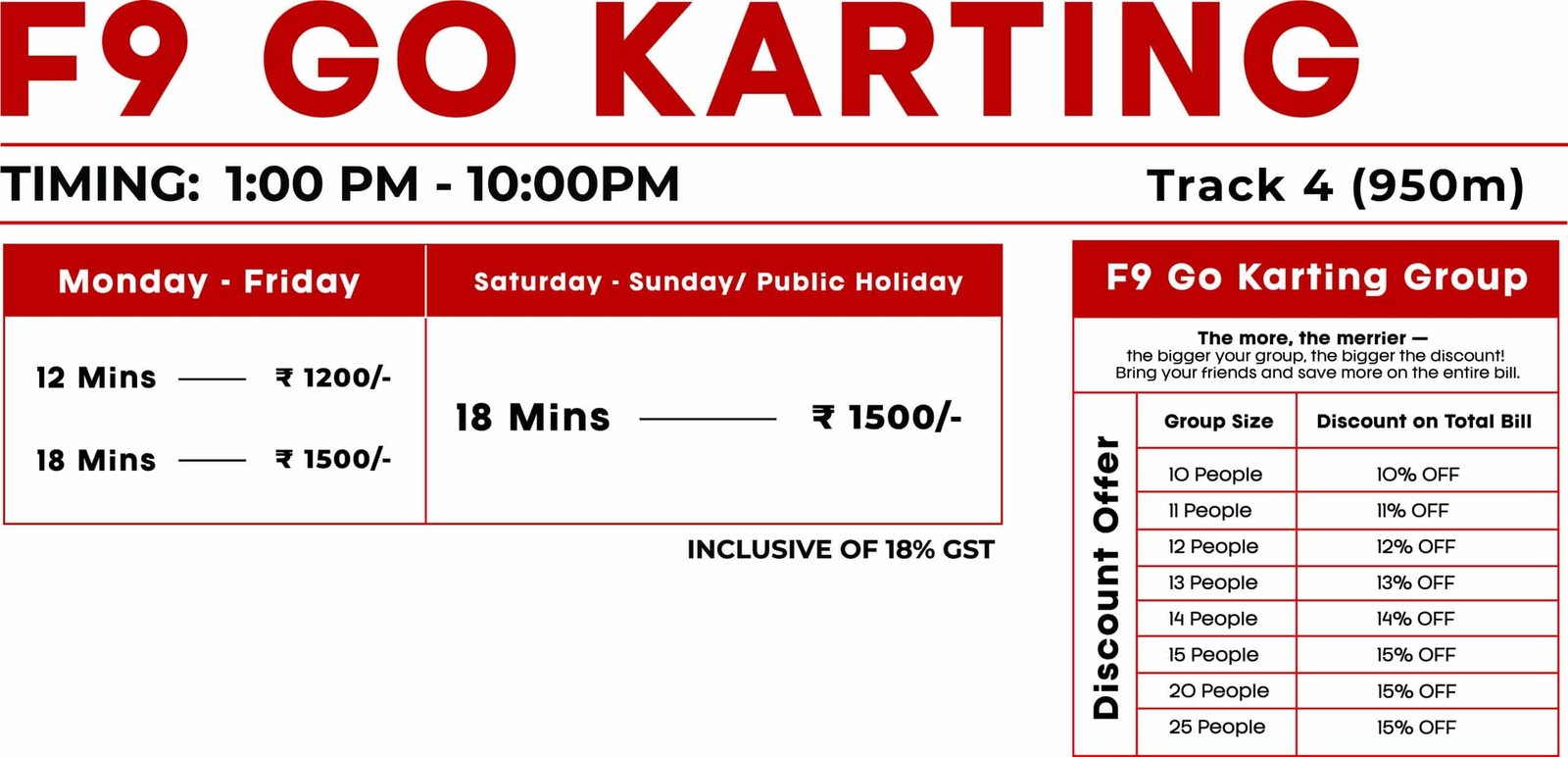
A longer lap does not mean a more expensive minute. Weekend pricing across the network sits in a narrow band per minute regardless of circuit length, so the 450-metre track and the 1,050-metre track cost similar amounts for the same time on track. What differs is what you get inside that time: more laps, or more distance per lap.
Midweek, the same is true of laps. A ten-lap session at Sector 68 covers 10.5 kilometres; ten laps at Link Road covers 4.5. You pay more per lap on the long circuit, and you get more track under the kart for it.
Questions about track length
Is longer always better? No. Longer suits drivers who can use the space. Shorter suits beginners, children and anyone who wants many laps in a short session.
Does a longer track mean higher top speed? Not necessarily. Top speed depends on the kart and the longest straight. It is average speed that a longer lap tends to raise, because there are fewer corners per hundred metres.
Can I drive two circuits in one day? Only if you plan transport. Sector 17/18 and Sector 59 are on the same side of the city; GT Karnal Road and Baghpat are an hour north, and each circuit is priced separately. Drive times from Sohna Road and Golf Course Road to each one are in the go karting Sohna Road guide.
The quickest way to decide is to ask what your group has done before. Then check the drive to the two circuits that fit. Contact F9 Go Karting if you want a recommendation for your group size, or open the Link Road directions to see how close the short circuit actually is.
If the question behind the question is why the short lap feels quicker even when it covers less ground, why do go karts feel fast sets out the three effects that decide it.