
Most go karting for beginners advice is either obvious or wrong. You already know you should not crash. What you do not know is why your first session will feel clumsy for three laps and then suddenly click, or why the fastest-looking driver in your group will probably spin.
This guide is the briefing you should get before your first run: what happens from the moment you arrive, how the pedals and steering actually behave, the four habits that make a beginner quick, and what a first session costs at each F9 circuit.
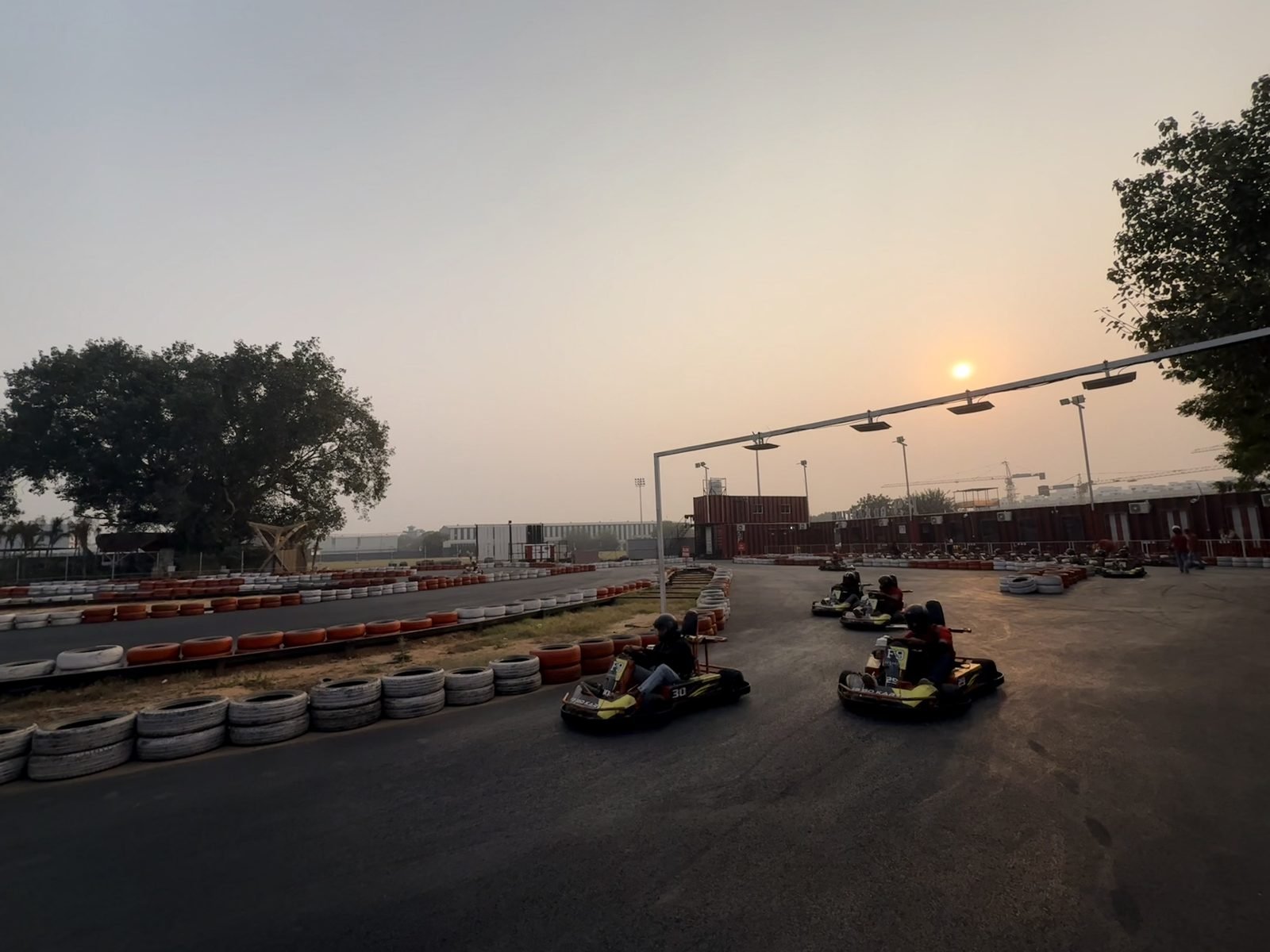
Go karting for beginners: what actually happens
A session runs in a fixed order and nobody skips a step.
- Sign-in. Your name goes on the timing sheet, which is how your laps get recorded.
- Helmet fitting. Yours needs to be snug. A loose helmet blurs your vision at speed and is the reason people complain about headaches afterwards.
- Briefing. Flags, overtaking rules, the line, what to do if you spin. Listen to the spin part; it will happen to someone in your group.
- Out lap. You leave the pit area behind a marshal or at reduced pace. Treat the first lap as a sighting lap, not a lap time.
- Timed laps. Then the session ends and you get a printout or screen with every lap time and the gap to the group’s best.
The timing sheet is the part beginners underestimate. Seeing that you lost 1.8 seconds in one corner is far more useful than a general feeling that you were slow.
What to wear
- Closed shoes with a flat sole. This is not a dress code, it is the control interface: you brake and accelerate with your feet.
- Trousers or jeans. Shorts are fine in hot weather but denim protects your legs from the kart’s hot parts.
- A fitted top. Loose sleeves and jackets flap and distract at speed.
- No scarf, no dangling jewellery, no long hair loose. Tie it back.
- Gloves if you have thin ones. Not essential, but they help if you grip the wheel hard.
The first three laps: what to do
Your first three laps have one job: learn where the corners are. Do not chase a lap time.
- Lap one: note the two corners where you had to brake hard. Everything else is memory.
- Lap two: brake earlier than you think you need to, at the same point each time. Consistency first.
- Lap three: look one corner ahead instead of at the nose of the kart. Your hands will follow your eyes.
By lap four most beginners are smoother than they were on lap one, and the lap time drops without any conscious effort. That is not talent arriving; it is the removal of panic braking.
How the kart responds
Power goes to the rear wheels and steering happens at the front, but because there is very little weight over the rear axle, the back end lets go first. That has three consequences a first-timer needs to know.
- Brake in a straight line. Braking while turning unloads the rear and the kart rotates further than you asked. That is the classic beginner spin.
- Squeeze, do not stamp. A stamped brake locks the rear wheels and you slide. Progressive pressure keeps grip.
- Smooth hands. One input at a time: brake, then turn, then accelerate. Beginners who do all three at once are the ones who look busy and go slowly.
Therefore the beginner’s lap is not the dramatic one. It is the quiet lap where nothing happens and the time is two seconds faster than the noisy one before it.
Track rules you will actually use
- No contact. Bumping is not racing, it is a black flag and often the end of your session.
- Blue flag. A faster kart is behind you. Hold your line, do not swerve to let them past.
- Yellow flag. Slow down and do not overtake. Someone is stopped ahead.
- Black flag. You are being called in. Usually for contact or repeated corner-cutting.
- Chequered flag. Session over. Slow down and return to the pit area behind the marshal.
The four mistakes almost every beginner makes
- Braking mid-corner. The single biggest time loss. Brake before the turn, then be back on the power as you exit.
- Following the kart in front too closely. You end up copying their mistakes and losing your own line. Leave two kart lengths and drive your own lap.
- Fighting the wheel. When the rear steps out, beginners add more steering lock. Correcting gently and unwinding does more.
- Exiting too early on the last corner. Everyone wants to be fast onto the straight, and everyone runs wide. Late entry, straight exit.
What a first session costs
All F9 rates include 18% GST. A first visit should be the shortest package on the closest circuit, because you will be tired before you expect to be.
- Sector 17/18 Link Road (450 m): weekday 16 laps ₹700, 22 laps ₹800, 34 laps ₹1,100.
- Sector 59 (850 m): weekday 10 laps ₹900, 15 laps ₹1,100.
- Sector 68 (1,050 m): weekday 10 laps ₹900, 15 laps ₹1,100.
- GT Karnal Road (950 m): weekday 12 laps ₹900, 18 laps ₹1,100.
On a weekend those cards change to minutes: 11 minutes for ₹800 at the smallest circuit, or 12 minutes for ₹900 at GT Karnal Road. If you have never driven before, buy the shortest option at whichever circuit is nearest and come back for the longer package once you know you like it.
Age and height
Minimum age and height differ by circuit because the kart fleets differ. Ask the track for the exact minimum when you book, particularly if a younger teenager is coming along. It is the one detail that cannot be sorted out on the day.
How to tell you are getting better
Beginners usually improve faster than they expect, and the signs are not the ones people look for. Speed at the end of the straight is the last thing to arrive. The first three signals are these:
- Your lap times stop varying. Three laps within half a second of each other is a real milestone, and it comes before the laps get fast.
- You brake at the same point without thinking. That is the point where the circuit has moved from unfamiliar to known.
- You are not out of breath at the end. Tension, not fitness, is what tires out a first-timer. Loosening your grip on the wheel usually takes a second off the lap.
Is karting tiring?
More than it looks. There is no power steering, so your arms and shoulders do the work, and the lack of suspension sends every bump through the seat. Eighteen minutes is a comfortable session for a first-timer; thirty-five minutes is genuinely hard work if you have not driven before.
That is why the shortest package is the right first purchase. Two people sharing a long session often find that the second half is slower than the first, and the timing sheet shows it. Come back a second time before you buy the big block — the birthday party page is the shortcut if you want to bring a group along.
Frequently asked questions
Do I need any experience to drive?
No. The briefing covers everything a first-timer needs, and the first lap is run at a reduced pace. Beginners are the majority of most sessions.
How long is a beginner session?
Between 11 and 18 minutes of track time in most packages, which is around 16 to 34 laps on the shorter circuits. That is plenty for a first visit.
Will I be racing against experienced drivers?
Possibly, in a shared session. Ask for a beginner group or book a private block if you would rather drive with your own party only.
Where to go next
Every circuit is listed on the tracks page. First-timers on this side of the city usually start at Sector 17/18, while groups looking for room to learn a line head to Sector 68. For directions, open F9 Go Karting on Google Maps.
Prices are the published F9 rate cards and include 18% GST. Checked in October 2026.


3 Responses