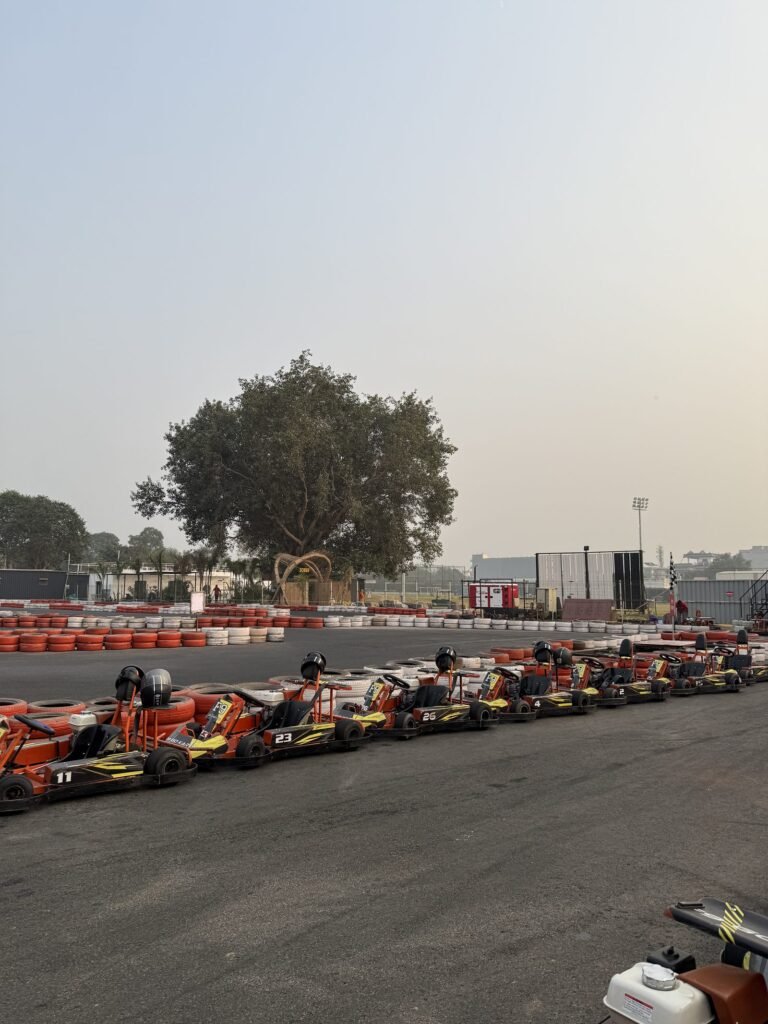
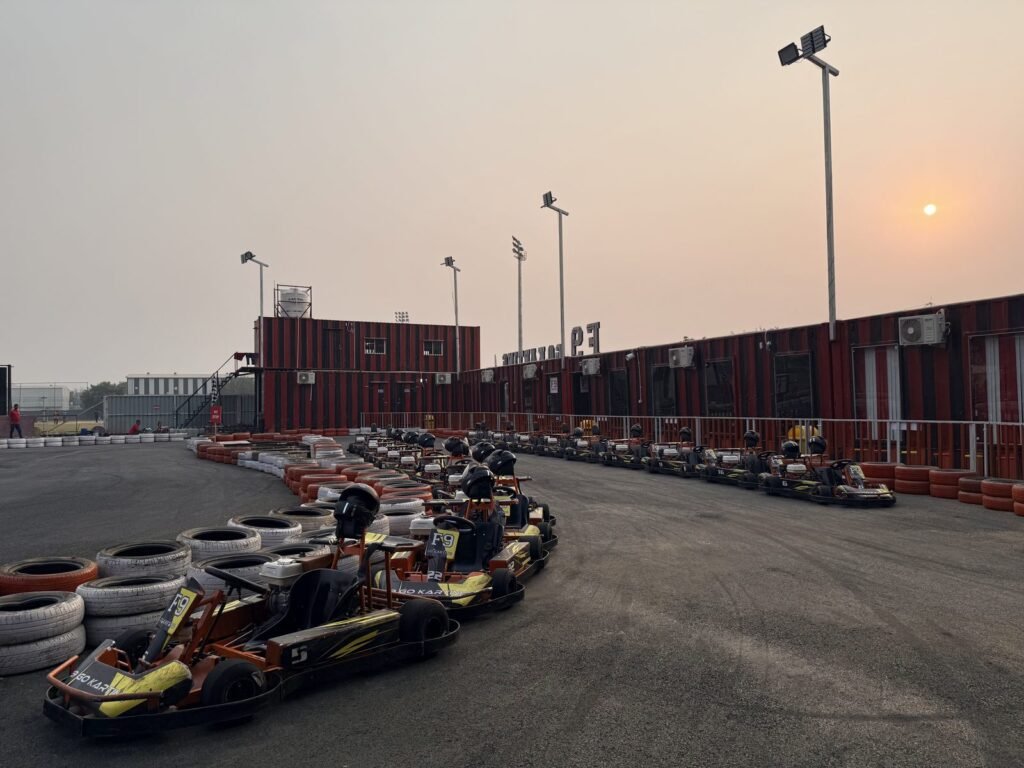
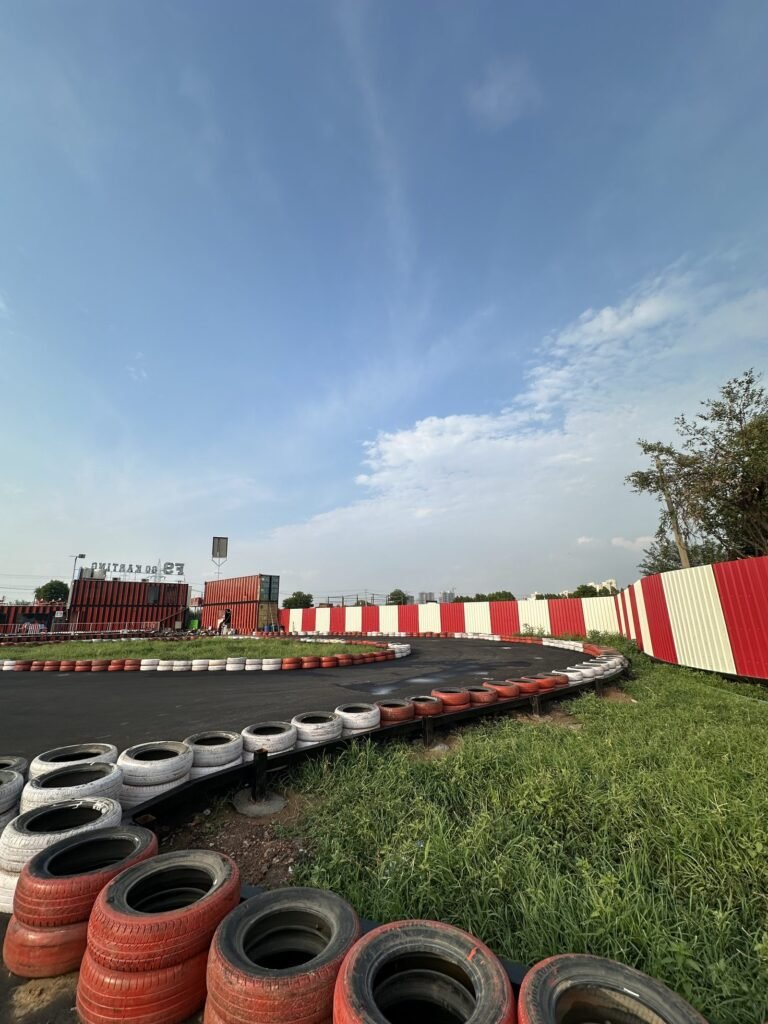
A corporate team outing go karting Gurgaon teams actually talk about afterwards has one thing in common: everybody drove. Not everybody watched, not everybody queued. That is the whole argument for a track over a conference room, and it is also the thing most outing planners get wrong when they book a single heat for twenty people.
This is a planning guide for the person who has to make the booking: the formats that work, how to structure heats for a group of twelve or twenty, what the karts actually cost per head, and the operational details that decide whether the afternoon runs on time.
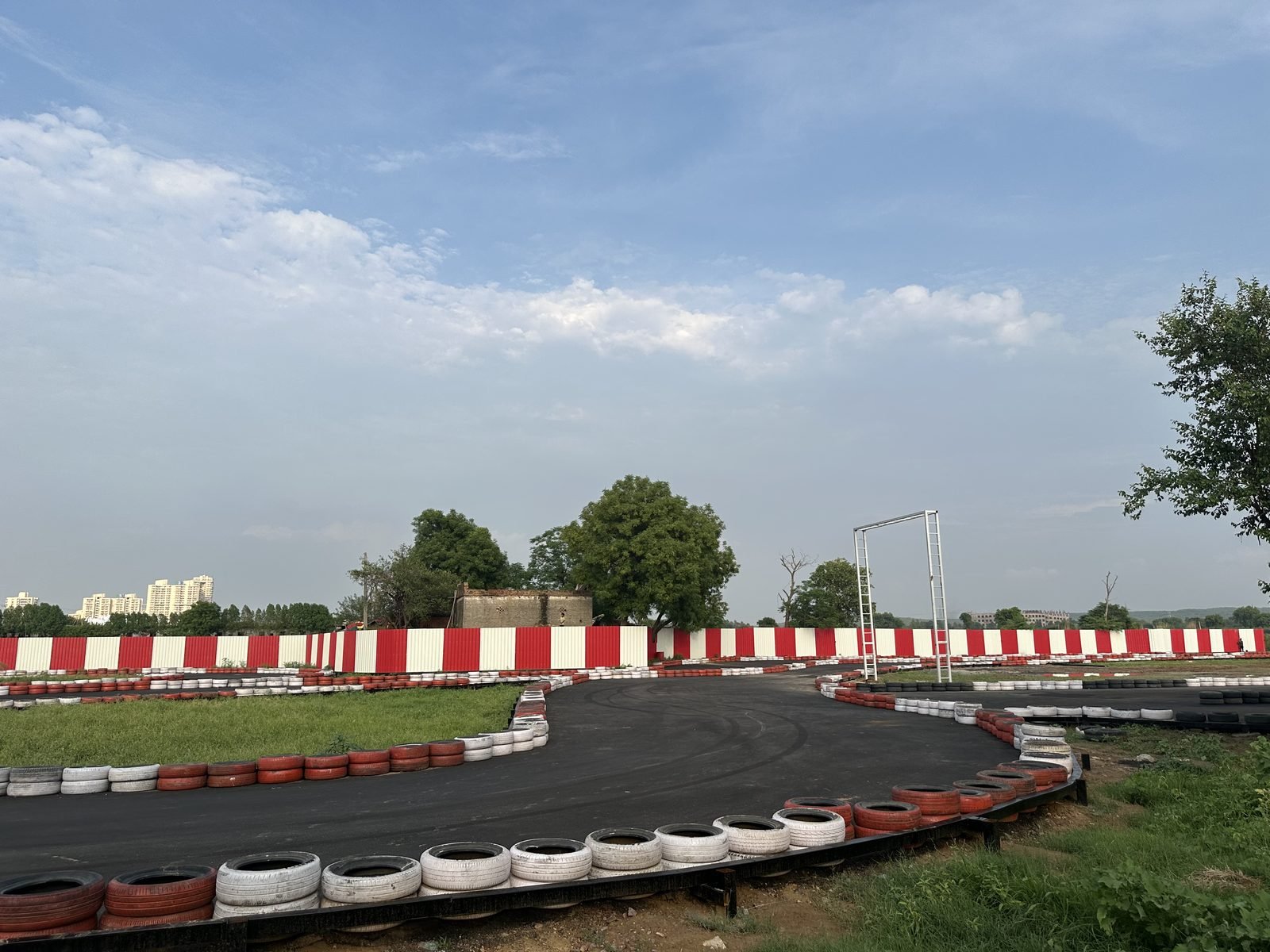
Why karting works as a team outing
Most corporate activities split a room into participants and spectators. Karting does the opposite. The karts are booked as a block, the grid is filled by your own group, and the person who normally runs the meeting is on track with everyone else, with no authority over the outcome.
- No skill barrier. Nobody arrives already good at it, so seniority buys nothing.
- Timed results. A lap sheet gives you an objective scoreboard to talk about.
- Short rounds. An eighteen-minute heat fits a working afternoon without eating the day.
- Equal attention. Two heats means everyone drives twice, including the cautious half of the team.
Corporate team outing go karting Gurgaon: choose a format
Four formats cover almost every group. Pick one before you call the venue, because the format decides the kart count and the length of the booking.
Sprint Grand Prix
Two or three short heats plus a final. Best for groups of eight to sixteen. Everyone races every heat, points are added, the top six go to the final. This is the format that produces the most conversation afterwards, because the final has a story.
Time attack
Everyone drives the same number of laps and the fastest single lap wins. Simplest to run and the fairest for a mixed-ability group, since traffic and grid position matter less. Good for groups where several people have never driven before.
Endurance relay
Teams of two or three share karts in rotation for a fixed duration. This is the format that actually rewards teamwork, because pit stops and driver changes are part of the result. It needs a longer booking than a sprint.
Head-to-head knockout
Pairs race, winners advance. Best for a group of eight where the aim is a social bracket rather than a team result. The downside is that half the group is waiting at any moment, so it suits a smaller headcount.
Kart counts and what they cost
F9 sells group sessions as kart blocks. The rates below are per block, inclusive of 18% GST, and apply at the Sector 68 and Dwarka Expressway circuits.
- 12 karts: ₹21,000 or ₹35,500 depending on session length.
- 20 karts: ₹32,000 or ₹52,000.
Divide those numbers by the number of drivers and you get the per-head figure your finance team will ask for. Twelve karts works out to ₹1,750 or about ₹2,958 per person. Twenty karts works out to ₹1,600 or ₹2,600 per person. The twenty-kart block is the better value per head, which is why it is worth filling the grid even if a few colleagues only come for the food.
For a smaller team, the Sector 17/18 circuit sells six-kart blocks at ₹6,600 for eighteen minutes, ₹11,500 for thirty-five, and ₹15,000 for fifty. That is about ₹1,100 per kart at the entry level, the cheapest way to put a team of six on track.
The Sector 59 venue is the middle option: an 850 m circuit with 15 and 30 minute weekend sessions at ₹1,100 and ₹2,100, and weekday laps at 10 for ₹900 or 15 for ₹1,100. It suits a team of ten to fourteen who want a longer track than Sector 17/18 without filling a twenty-kart grid.
Structuring the afternoon for twenty colleagues
Twenty people, twenty karts, one grid. That is the cleanest configuration and it is the one to aim for. If you cannot fill twenty karts, use twelve karts with two drivers per kart and a driver change between heats.
- Heat 1: everyone races, grid drawn at random. This establishes a baseline time for each driver.
- Driver change or reset: ten minutes, karts refuelled and re-gridded.
- Heat 2: reverse grid, so the slowest from heat one starts at the front. This is what keeps the second half of the group engaged.
- Final: top six on combined time, four to six laps, then a podium.
Two heats plus a short final fits comfortably into two hours including briefing and photographs. Three full heats plus a final needs closer to three hours, and that is where corporate bookings start to overrun.
The details that decide whether it runs on time
- One arrival time. A block booking starts when the block starts. Ten people arriving on time and ten arriving in dribs does not delay a track, it delays your own briefing.
- Closed shoes. Send that line in the calendar invite. It is the most common reason someone cannot drive.
- Names on the timing sheet. Give the venue a list in advance so results print with names rather than kart numbers.
- One decision maker. Nominate a single person to confirm the format and the final headcount. Group chats produce three versions of the plan.
- Weather plan. All six circuits are outdoor. If the forecast is doubtful, ask the venue what happens to a booking in rain before you pay.
What to confirm with the venue
Ask these five questions when you book, and get the answers in writing:
- Is the quoted rate per kart or per person, and does it include GST?
- What is the minimum age and height for the circuit, in case someone brings a teenage intern or a family member?
- Is seating available for the group, and is food allowed on site or arranged by the venue?
- What is the cancellation and rescheduling policy?
- Does the venue provide helmets and briefing, or should drivers bring anything?
A two-hour running order
- 0–15 min: group arrives, headcount confirmed, helmets fitted.
- 15–25 min: safety briefing and format explained to the whole group at once.
- 25–45 min: heat one.
- 45–55 min: break, timing sheet posted so people can see their laps.
- 55–75 min: heat two, reverse grid.
- 75–90 min: final for the top six, everyone else watching from the barrier.
- 90–120 min: results, photographs, food.
Posting the timing sheet between heats costs nothing and changes the mood of the afternoon. People start comparing sector times instead of standing around, and the second heat becomes competitive rather than ceremonial.
Budgeting the outing
Build the budget in three lines rather than one. First, the kart block, which is the only line the track controls. Second, food, whether that is on site or at a restaurant afterwards. Third, transport, which for a group of twenty is usually a bus rather than twenty cars.
A twenty-kart block at ₹32,000 works out to ₹1,600 per person and is far cheaper than the same money spent on a restaurant dinner with a set menu, and it takes about the same time out of the working day. If the budget is tighter, a twelve-kart block with two drivers per kart halves it without halving the experience.
Common mistakes
- Booking one heat for twenty people. Someone will leave having driven for eight minutes.
- Choosing the longest session instead of the extra heat. Two short races beat one long one.
- Forgetting GST in the budget. F9 rates already include 18%, which makes comparison easier, but a quote from elsewhere may not.
- Booking a weekday slot without checking who can actually leave the office.
- Skipping the group photo on the grid. It is the only part of the day that ends up on LinkedIn.
Frequently asked questions
How many people can race at once?
Up to twenty karts in a single block at Sector 68 and Dwarka Expressway, and twelve karts for the mid-size block. Larger groups are run in rotation, which is why the format matters.
What does a corporate karting outing cost per head?
Between ₹1,600 and ₹2,958 per driver depending on the block and session length, inclusive of 18% GST. Six-kart blocks at Sector 17/18 come in at about ₹1,100 per kart at the entry level.
Do we need to bring our own gear?
No, but closed shoes are compulsory for everyone driving. Helmets and the safety briefing are handled at the track.
Where to go next
Compare the circuits on the tracks page, or send the requirement straight to the venue through the contact page with your date, headcount and preferred format. For directions, open F9 Go Karting on Google Maps.
Prices are the published F9 group rate cards, inclusive of 18% GST, checked in October 2026. Group rates apply per kart block, not per person.