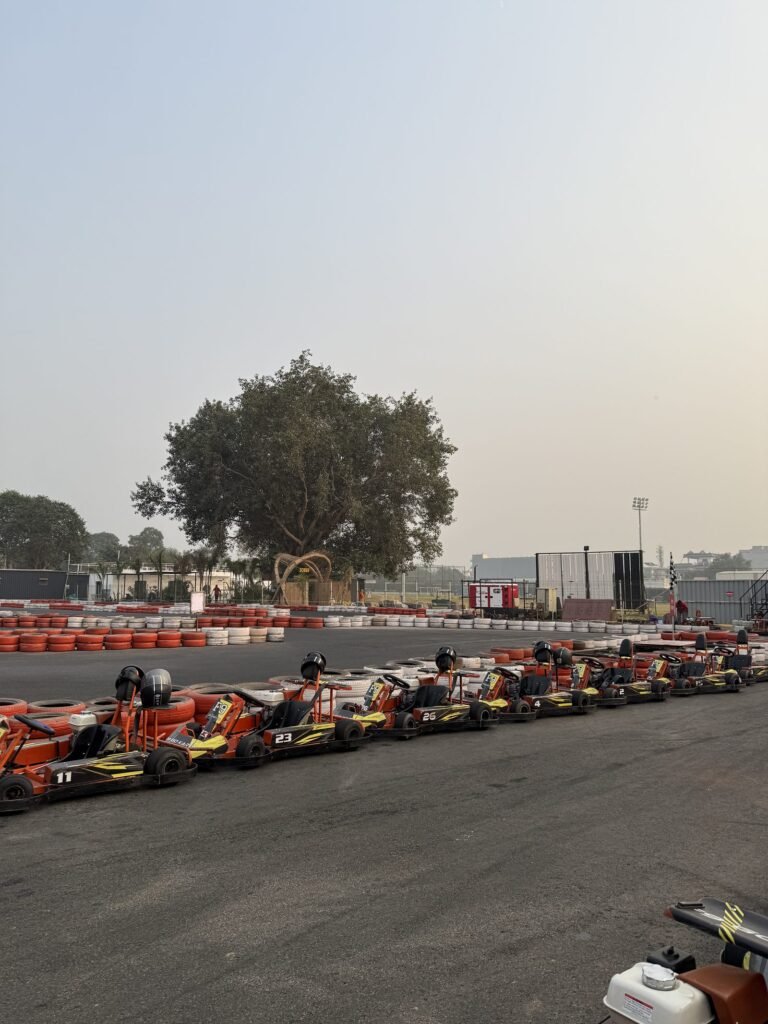
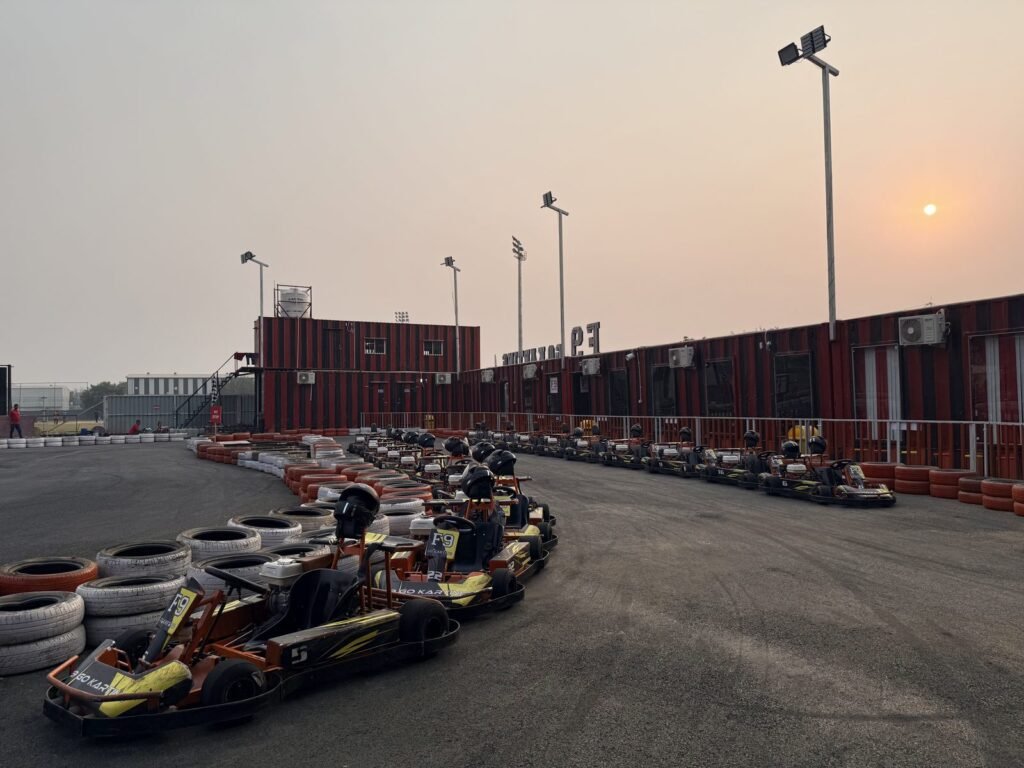
The short answer to what to wear go karting is: nothing that flaps, nothing that dangles, and shoes you would be happy to brake hard in. Everything else is detail, and the detail is worth ten minutes because the wrong choice is uncomfortable for the whole session rather than just the first lap.
This guide covers footwear, clothing for a Gurgaon summer against a December morning, and the specific things that should stay in the car.
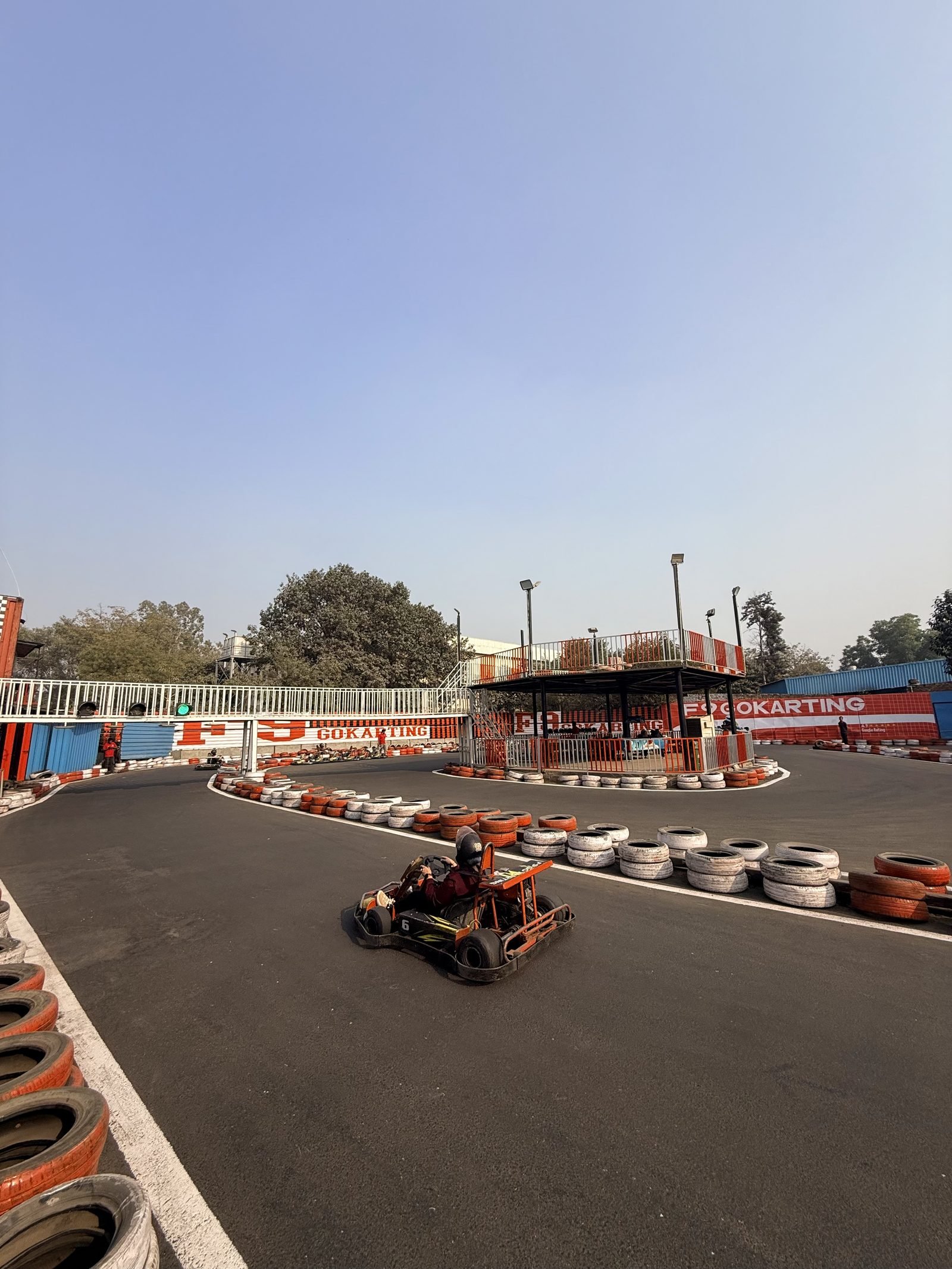
What to wear go karting: the short version
- Shoes: closed, thin-soled and laced. Trainers are ideal, running shoes are fine, anything open is not.
- Trousers: jeans, chinos or track pants. Something with a bit of grip on the seat.
- Top: a close-fitting t-shirt or long-sleeve top. Layers in winter, one thin layer in summer.
- Hair: tied back if it reaches your shoulders.
- Jewellery: off. Rings, watches, bracelets and anything on a chain.
- Helmet: provided at the circuit, so no need to bring one.
Footwear is the one that really matters
Your feet do two jobs in a kart: they press a brake pedal that needs a firm shove and a throttle that needs a small, steady squeeze. A thin sole lets you feel both. A thick foam sole blunts the feel and makes smooth braking harder, which is exactly the skill that separates a tidy lap from a scrappy one.
Open shoes are a bad idea for a more basic reason. The footwell is not sealed, the pedals are metal, and a sandal offers no protection if your foot slips off. Flip-flops also tend to come off entirely, which is its own problem mid-session.
If you own karting boots, wear them. If you do not, any trainer with a flat, thin sole is the next best thing.
Clothing for a Gurgaon summer
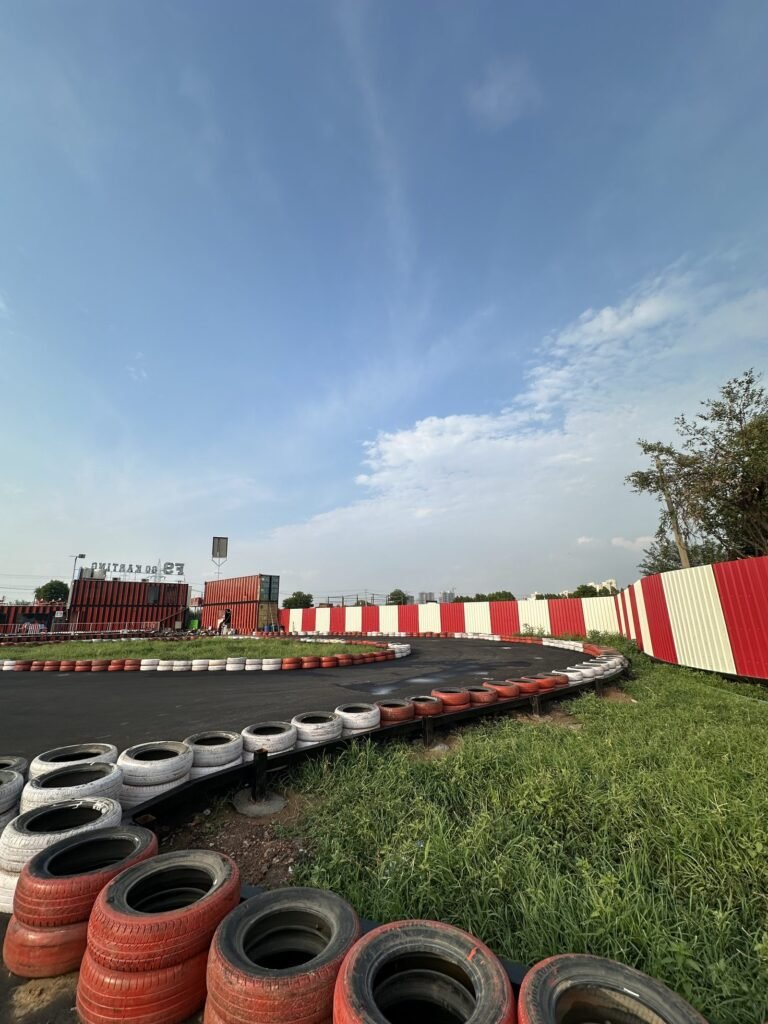
All six F9 circuits are outdoors, and between April and June the track surface gets hot enough to notice through a seat. Wear one thin layer, choose a light colour, and skip the denim jacket you will end up holding.
Long sleeves are worth considering even in the heat. They protect your arms from sun while you are standing around waiting for your heat, and they stop a seat belt or harness edge from rubbing. A cotton or technical t-shirt with a light overshirt is the practical combination.
Shorts are acceptable and common in summer. The trade-off is exposed knees against a hot seat and a fibreglass shell, so shorts work better for a short session than for a long one.
Clothing for a winter morning
Gurgaon winters change the calculation completely. A kart offers no shelter and the wind on an open circuit makes it colder than the same temperature standing still. Dress as you would for a walk, then remove one layer before you get in the kart, because layers that bunch up behind your back make the seat uncomfortable and stop you from sitting properly.
Gloves are the useful addition. A thin pair improves grip on a wheel that gets cold, and they protect your hands from blisters if the session is long.
What not to wear
- Anything loose. A scarf, a long open jacket, a flowing dupatta. Loose fabric has no business near a rotating rear axle.
- Long necklaces, lanyards and ID cards. They will swing, catch and distract. Take them off before the briefing, not after.
- Big rings and thick watches. They change how you hold the wheel and they can catch on the rim.
- Open footwear. Covered above, and it is the single most common mistake.
- Anything you would be upset to lose. Things fall out of pockets in a kart. Phones included.
Hair, glasses and the helmet
The helmet goes over your head, so hair has to be flat and tied. A low ponytail or a bun at the nape is comfortable; a high bun is not, because it stops the helmet sitting down properly.
Glasses are fine and stay on inside a full-face helmet. Tell the marshal if you wear them, so the helmet is fitted with that in mind. Contact lens wearers have an easier time of it, but nobody needs to change their habits for a session.
The helmet itself is provided and is the one piece of equipment you do not need to think about. If you have your own and it fits, bring it; if not, use the circuit’s.
What the circuit provides
Every F9 session includes the kart, the helmet and the safety briefing. That is the whole equipment list, which is why the clothing question is really about what you bring rather than what you buy.
It also explains why so little of this matters to a first-timer: you can arrive in jeans and trainers, listen to the briefing, and drive. The people who suffer are the ones who turn up in open shoes or a long scarf, and both mistakes are avoidable in advance.
What not to carry
The kart has no glovebox and no door pocket, and anything in your jeans will be pressed against a seat for the whole session. Keys, coins and a phone are better left with whoever is watching. A phone in a front pocket is not only uncomfortable, it is the item most often lost at a circuit, because it slides out when a driver climbs in.
If you need to keep a phone on you, a zipped pocket is the only version that survives a session. Everything else goes in a bag at reception.
Does what you wear actually change your lap time?
A little, and in one specific way. Thin soles give better pedal feel, close-fitting clothes stop fabric pulling against the harness, and a properly fitted helmet keeps your head still when you look through a corner. None of that is worth a second a lap on its own, but it is free, and free is a good price for a cleaner session.
The bigger effect is comfort. A driver who is too hot, or whose shoe is slipping, stops thinking about the next corner. That is where the time goes.
Frequently asked questions
Can I wear shorts go karting?
Yes, shorts are fine, especially in summer. Trousers protect your legs better against a hot seat and the kart body, so they are the safer choice for a long session.
Do I need to bring my own helmet?
No. Helmets are provided with every session. Bring your own only if you already have one that fits well.
Are open shoes allowed?
Wear closed shoes. A kart’s pedals are metal, the footwell is open, and the brake needs a firm push. Trainers are the practical answer.
Should I bring gloves?
In winter, yes. A thin pair improves grip on a cold wheel and protects against blisters. In summer they are optional.
Is there anywhere to leave a bag?
Ask at the circuit when you arrive. Every F9 track has a reception, and leaving a bag there is routine, but valuables are better left at home.
Where to go next
If this is your first session, read the beginner guide before you arrive. Then pick a circuit on the tracks page — the Sector 17/18 Link Road loop is the shortest and easiest to learn on. Group enquiries go through the contact page. For directions, open F9 Go Karting on Google Maps.