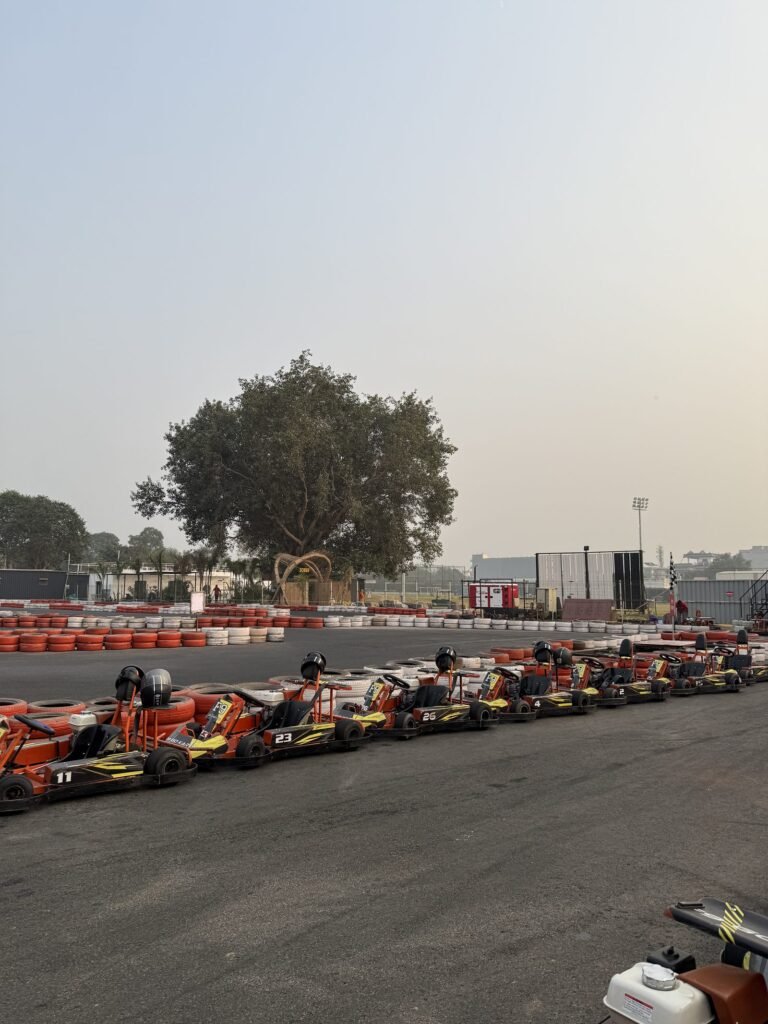
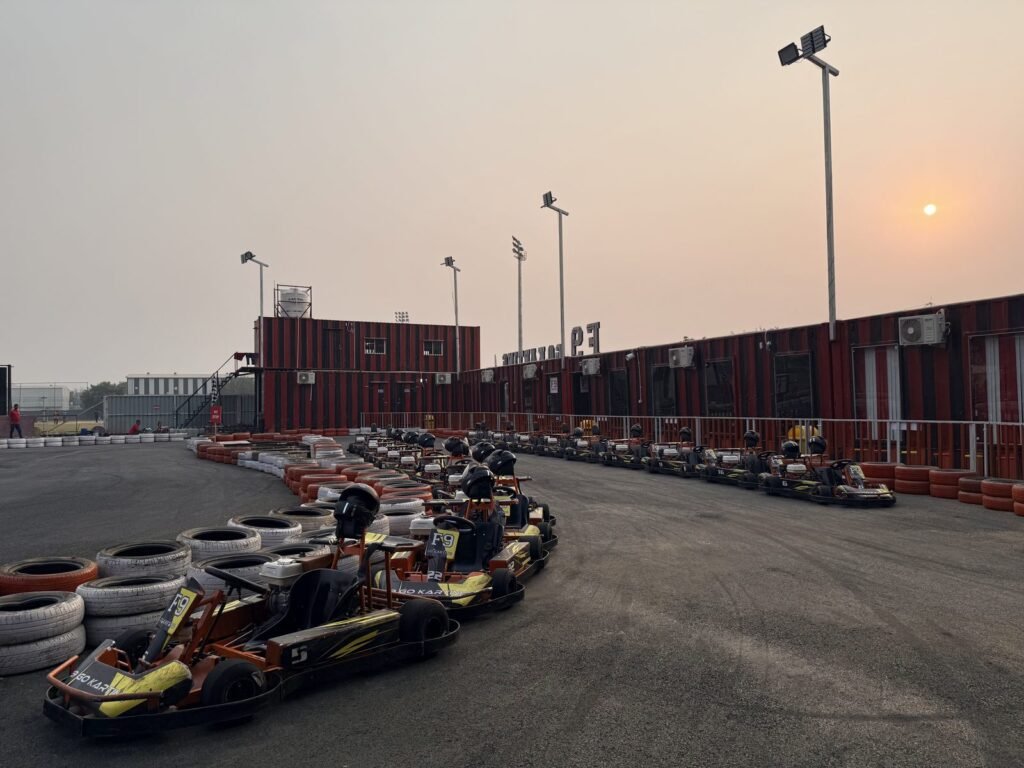
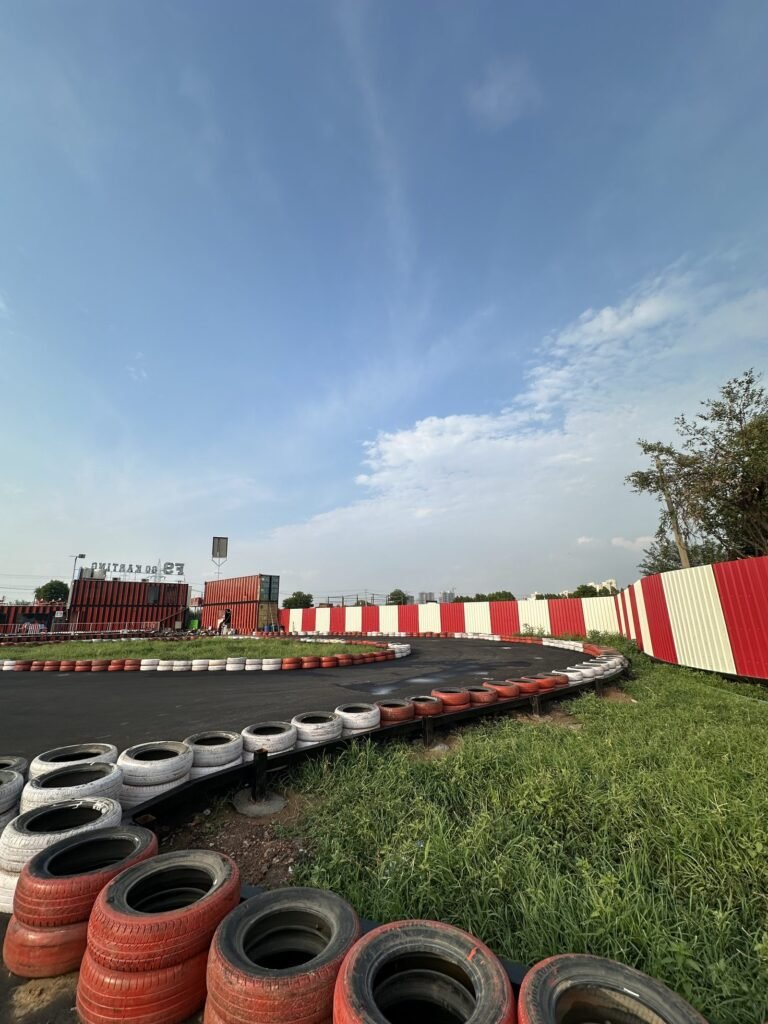
The indoor vs outdoor go karting question usually gets answered with a preference rather than a reason. Indoor feels convenient, outdoor feels faster, and both are partly true. The useful version of the question is narrower: which one produces the session you are actually trying to have in Gurgaon, on the day you are planning it?
This guide sets the two side by side on the things that change the experience, and it is written from the outdoor side of the fence, because all six F9 circuits are outdoors.
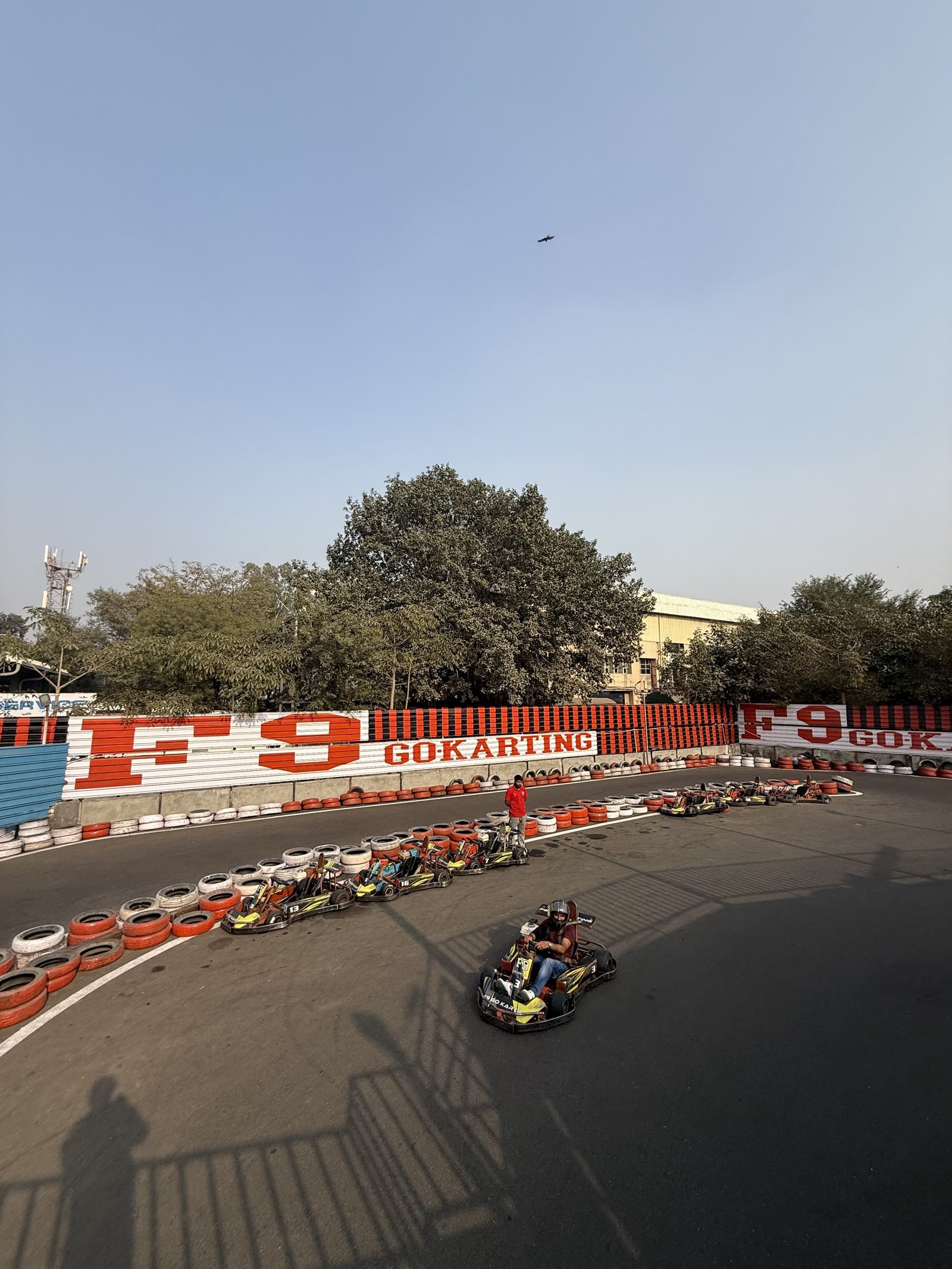
Indoor vs outdoor go karting: the differences that matter
- Track length. Outdoor circuits need land, so they are longer. F9 runs from 450 metres at Sector 17/18 to 1,250 metres at Baghpat. Indoor tracks are built inside a building, which limits how long a lap can be.
- Grid size. Land again. Sector 59 and Sector 68 take twenty karts at once. Indoor venues rarely hold that many on track together.
- Weather. Outdoor sessions are at the mercy of rain and heat. Indoor is unaffected, which is the strongest argument for it in July and August.
- Speed and space. A long outdoor lap gives a driver room to build speed and a corner to brake for. A short indoor lap is a succession of turns with little straight between them, which is technical but rarely feels fast.
- Light and air. Outdoor sessions run under open sky in daylight, with nothing overhead and no walls close to the track.
- Cost per minute. Outdoor circuits can carry more karts and longer sessions, and the price per driver falls as the grid grows.
Why outdoor wins for groups
If the session is for a team, a birthday or a group of friends, track length is the thing that decides whether the event feels like an occasion. Twenty karts spread around an 850-metre circuit produce a real race. Twenty karts on a short indoor loop produce a traffic jam.
The second reason is the format. Outdoor circuits sell laps on weekdays and time at weekends, and both formats give a group a defined session rather than a vague number of circuits. A group that knows it has thirty minutes on track plans around it, and a group that knows it has ten laps chases a time.
The third is the venue itself. An outdoor circuit has space for spectators to watch from the barrier, which is what makes a birthday feel like an event rather than a waiting room.
When indoor is the better call
Three cases where the argument flips.
First, rain. All six F9 circuits are outdoors, and a session cannot run on a wet track. If the date is fixed and cannot move, indoor takes weather out of the equation entirely.
Second, peak summer heat. Gurgaon in May is hot enough that an outdoor session becomes a test of endurance rather than skill. A shorter session, or an indoor venue, is the sensible answer.
Third, a small group that wants a short run. Two or three drivers who want twenty minutes of karting are better served by the venue with the shortest travel and the least ceremony, and an indoor track near home often wins on both.
What to check before booking either
Four questions do most of the work, and they apply to indoor and outdoor venues alike.
- How long is the lap? A metre count tells you more than a marketing description. Under 500 metres is short, 800 metres is a proper circuit, and anything over a kilometre is a track you will still be learning on your third visit.
- How many karts go out together? For a group, this is the number that decides whether you race or queue.
- Is the session sold in laps or minutes? Laps give you a target, minutes give you a slot. Knowing which one you have bought prevents most disappointment.
- Is tax included in the headline price? Every F9 rate includes 18% GST, so the number on the rate card is the number you pay.
Surface and grip
Indoor tracks run on a sealed floor, and outdoor circuits run on asphalt. The difference shows up in how a kart behaves. Asphalt offers more grip when it is warm and less when it is cold or damp, so an outdoor driver has to think about track temperature across a session. A sealed indoor floor is more consistent from the first lap to the last.
Consistency is a real advantage for a first-timer, because there is less to adapt to. Variation is an advantage for anyone who has driven before, because it gives the lap another variable to work with. Neither is better in the abstract; they reward different things.
What an outdoor session costs
Rates at F9 are published per driver and include 18% GST.
- Sector 17/18, weekday: 16 laps ₹700, 22 laps ₹800, 34 laps ₹1,100.
- Sector 17/18, weekend: 11 minutes ₹800, 18 minutes ₹1,200, 35 minutes ₹2,100.
- Sector 68 and Dwarka Expressway, weekday: 10 laps ₹900, 15 laps ₹1,100.
- Sector 68 and Dwarka Expressway, weekend: 12 minutes ₹1,100, 15 minutes ₹1,200, 30 minutes ₹2,200.
The entry point at Sector 17/18 is the cheapest way to try an outdoor circuit, and it is also the shortest lap, which makes it the easiest place to learn the difference for yourself.
The verdict
For a group of six or more, on a date that is not in the monsoon, outdoor is the better session in almost every respect: longer laps, more karts, more space and a lower price per driver as the group grows. For a small group in the rain, or a session in the middle of May, indoor is the practical choice and there is no point pretending otherwise.
The outcome is not really a verdict on indoor against outdoor. It is a verdict on planning: the best session is the one whose format matches the group, and a group of twenty in an indoor venue is a queue.
Frequently asked questions
Is outdoor karting faster than indoor?
It usually feels faster, because a long lap has a straight to build speed on and a corner worth braking for. Lap length and layout vary by venue, so compare the metre count rather than the description.
Are F9 tracks indoor or outdoor?
All six are outdoors. They range from 450 metres at Sector 17/18 to 1,250 metres at Baghpat, which is a private hire ground rather than a walk-in circuit.
What happens if it rains?
Outdoor sessions cannot run on a wet track. The venue advises on conditions and rescheduling on the day, so keep a backup date if the booking is important.
Which is better for a birthday party?
Outdoor, for a group of six or more. There is space for spectators, a grid big enough for everyone to drive, and circuits that take twenty karts at once.
Can a group of twenty book an indoor venue?
Sometimes, but rarely on track together. Twenty karts need a big circuit, and that is the practical reason most large groups end up outdoors.
Where to go next
Compare all six circuits on the tracks page, check the weekend price guide for the lap against minute difference, or read the Sector 68 track guide for the longest lap in Gurgaon. Group enquiries go through the contact page. For directions, open F9 Go Karting on Google Maps.