Learning how to get faster go karting is mostly a matter of fixing things in the right order. Most drivers chase corner speed first, which is the last thing that pays. The gains come from braking discipline, then the line, then exit speed, and only after that from anything that looks dramatic.
This guide sets out that order, with the drills you can run inside a normal session and the habits that quietly cost beginners one to two seconds a lap.
How to get faster go karting: the order of gains
Think of a lap as three separate skills and work on one per session.
- Braking. Doing it in a straight line, at the same point, with progressive pressure. Worth the most time and costs nothing to practise.
- The line. Choosing an apex that lets you open the throttle early rather than one that looks fast on entry.
- Exit speed. The speed you carry onto the straight, which is the consequence of the first two.
- Everything else. Weight, kart setup, tyres. Real, but a distant fourth for a driver on a rental kart.
Therefore, if you only have one session to improve, spend it on braking points. Do not spend it trying to be braver into corners.
Braking: the largest single gain
Three rules cover almost everything.
- Brake before the turn, not during it. A kart brakes best with the wheels straight. Braking mid-corner unloads the rear and the kart rotates more than you asked.
- Pick a marker and use it every lap. A patch of tarmac, a cone, a barrier joint, the start of a kerb. Repeatability beats bravery.
- Squeeze, then release. Pressure builds over the first moment of braking, then eases as you approach the turn-in point. Stamping the pedal locks the rear and you slide.
Most beginners brake too late and too hard, arrive at the apex sideways, and then wait for the kart to straighten before they can accelerate. That wait is where the lap time goes. Braking ten metres earlier often produces a faster lap, because you are on the power ten metres sooner.
The line: apex late, exit straight
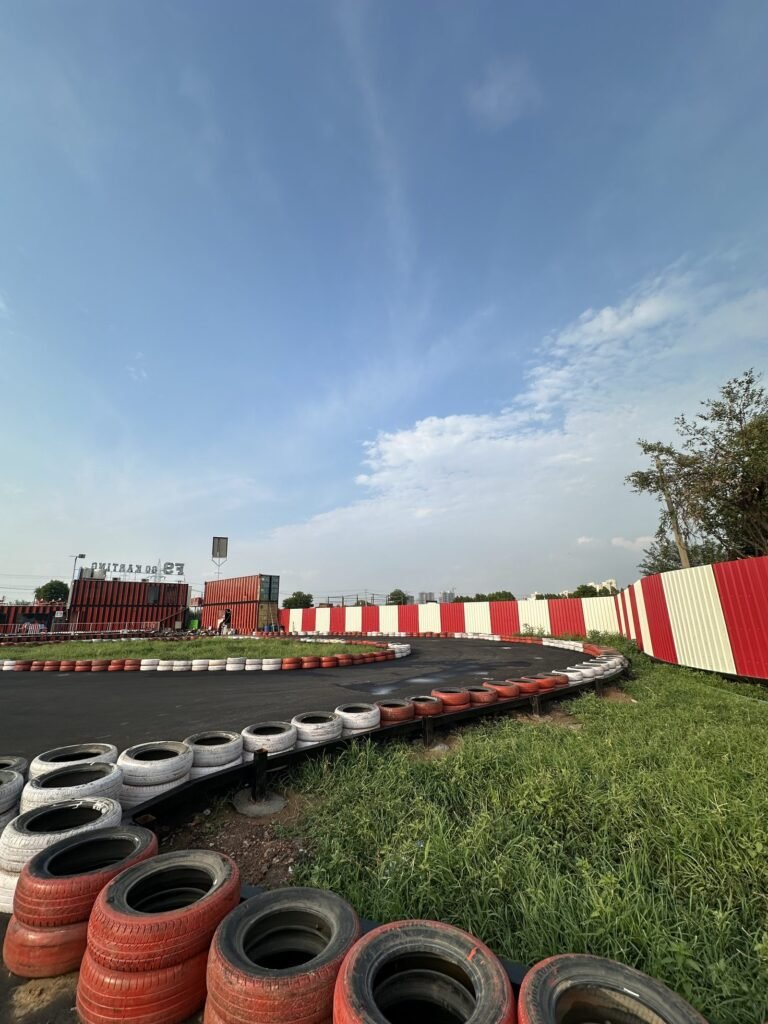
On a kart circuit, the fastest line is almost always a slightly late apex. Turning in early feels natural, because it points the kart at the corner exit, but it forces you to lift as the kart runs wide. A late apex keeps the kart tighter at the exit and lets you open the throttle without lifting.
A simple test: if you have to correct the steering after the apex, you turned in too early. The correction is the evidence, and it will show up as a slower lap on the timing sheet even when the lap feels quick.
Exit speed is the whole point
A corner exit feeds the next straight, and the straight is where speed actually accumulates. That is why a driver who is slow into a corner but early on the power usually beats a driver who brakes late and fights the kart out.
The drill: for one session, forget lap times and try to be the first on the throttle at the last corner before the longest straight. Watch what happens to your lap time. In most groups, this single change produces the biggest improvement of the day.
Look one corner ahead
Your hands follow your eyes, and your eyes should be where the kart will be in two seconds, not where it is now. Beginners stare at the apex they are about to hit and then arrive at it too early.
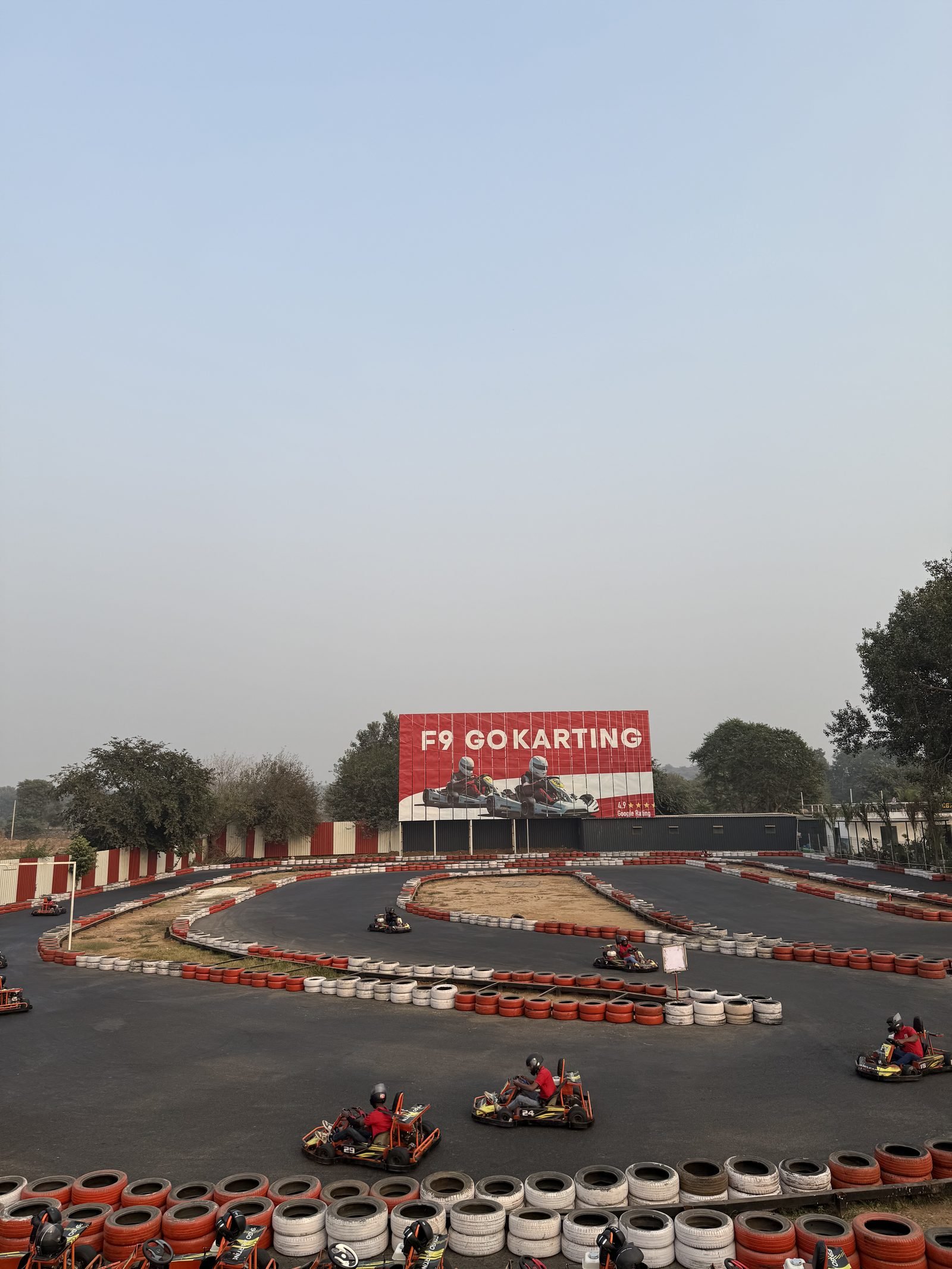
A practical version: as you approach a corner, find the exit of the next corner. On a short circuit like the Sector 17/18 loop you can almost always see two corners at once, which makes this easy to practise.
The habits that cost beginners time
- Gripping the wheel too hard. Tension travels down your arms and makes every input jagged. Loosen your grip and your lap gets smoother before it gets faster.
- Steering too much. If the kart is not turning, adding lock usually makes it worse. Unwind slightly and let the kart rotate.
- Braking in the corner. Covered above, and still the most common mistake in any session.
- Copying the kart in front. Follow a faster driver for a lap to learn their line, then drive your own. Two laps of copying is technique; ten is a habit.
- Rushing the first lap. The out lap is for warming tyres and finding the reference points, not for setting a time.
Three drills for a fifteen-minute session
You do not need a full track day to improve. A normal session is enough if you give each drill a purpose.
- Braking drill. Pick one corner. Brake at the same marker every lap for five laps, no matter how slow it feels. Consistency is the goal, and it will feel strange.
- Exit drill. Pick the corner before the longest straight. Forget everything else and try to be on the throttle earlier each lap.
- Consistency drill. Run three laps and try to make the times identical rather than fast. Three laps within half a second of each other is a better sign than one quick lap followed by two messy ones.
The timing sheet matters here, because feel is unreliable. A lap that feels slow is often the fastest of the session, and a lap that feels dramatic is usually the slowest.
What to measure
Three numbers are enough: your best lap, your average of the last three laps, and how much your lap times vary. The best lap tells you the potential. The average tells you what you can actually repeat. The variation tells you whether the improvement is skill or luck.
Ask for the printout at the end of the session. If the venue shows sector times, look for the single corner where you lose the most, and spend your next visit on that corner alone.
Does the kart or the driver matter more?
On rental karts, the driver matters more within a session and the kart matters more between sessions. Karts in the same fleet are rarely identical: tyre age, engine condition and even kart weight shift lap times by a few tenths. That is why a driver who wins one session does not automatically win the next.
Two practical consequences. First, do not over-analyse a single session. Second, if you are racing friends regularly, rotate karts between heats so nobody gets a lucky one.
Frequently asked questions
How long does it take to get faster at karting?
Most beginners find one to two seconds between their first and third session, purely from braking discipline and a cleaner line. Beyond that, the gains get smaller and more specific.
Should I brake later to go faster?
Usually not. Braking earlier and getting on the power sooner is faster on a kart circuit, because exit speed carries down the whole straight.
Which circuit is best for practising?
A short, technical circuit. The 450 m Sector 17/18 loop gives you more corners per minute, which means more repetitions of the skill you are working on. A long circuit is more rewarding once the basics are in place — see Sector 68.
Where to go next
Compare the circuits on the tracks page, read the birthday party formats if you are bringing a group, or send a session request through the contact page. For directions, open F9 Go Karting on Google Maps.
Session formats and rates are as published on the F9 circuits’ own rate cards, inclusive of 18% GST, checked in October 2026.