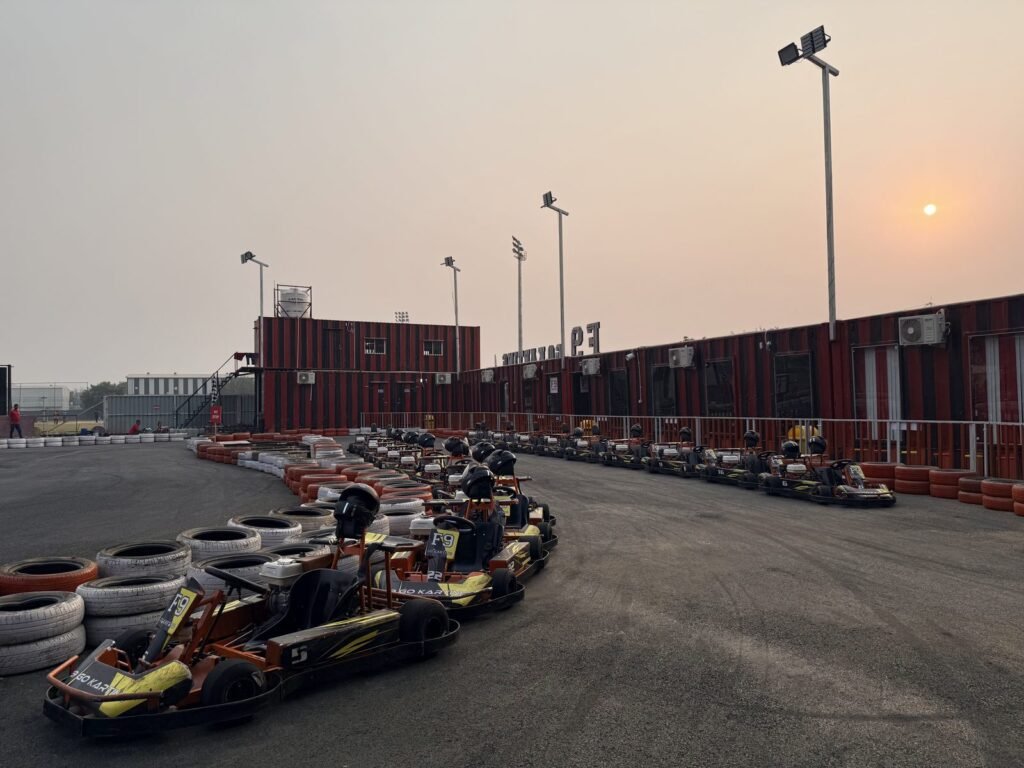
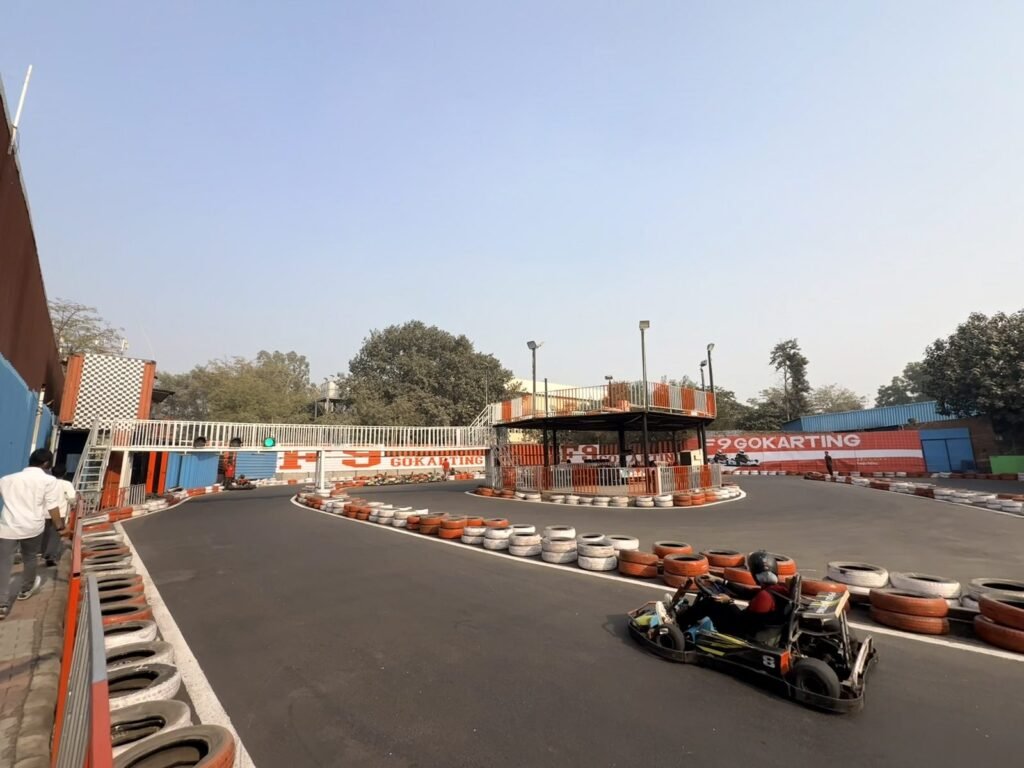
The Sector 68 Gurgaon karting track is the 1,050-metre circuit off Aklimpur Road, near Tulip Chowk, and it is the longest walk-in lap F9 runs inside the city. Most pages report that number and then go straight to the prices. The length deserves a closer look, because it changes three things that decide whether the session is worth the money: how many laps a fixed clock buys, how much of the session goes on learning the track, and how much clear road you get between karts.
None of the figures below is a posted lap time. F9 does not publish lap times, so the lap counts here are arithmetic at the averages used across these guides: about 40 seconds a lap on the 450-metre Link Road circuit and 72 seconds on this one. Treat them as estimates. The conclusions still hold, because they are ratios rather than records.
Sector 68 gurgaon karting track: the card, as published
| Product | Price per driver |
|---|---|
| Weekday, 10 laps | ₹900 |
| Weekday, 15 laps | ₹1,100 |
| Weekend, 12 minutes | ₹1,100 |
| Weekend, 15 minutes | ₹1,200 |
| Weekend, 30 minutes | ₹2,200 |
| 12 karts, 30 / 60 minutes | ₹21,000 / ₹35,500 |
| 20 karts, 30 / 60 minutes | ₹32,000 / ₹52,000 |
Every figure is per driver and includes 18% GST. Weekdays are sold in laps and weekends in minutes, which is why the two halves of that card cannot be read line for line. The address, phone number and full card sit on the Sector 68 circuit page.
What a fixed clock buys on a long lap
A minute is worth less here than at any other F9 circuit, because a lap takes longer. Twelve minutes is ten laps. Fifteen minutes is twelve and a half. Thirty minutes is twenty-five, which is roughly 26 kilometres of track.
| Block | Laps (est.) | Distance | Price a lap |
|---|---|---|---|
| 12 minutes, ₹1,100 | 10.0 | 10.5 km | ₹110 |
| 15 minutes, ₹1,200 | 12.5 | 13.1 km | ₹96 |
| 30 minutes, ₹2,200 | 25.0 | 26.2 km | ₹88 |
Read the last column, not the first. Twelve minutes looks like the cheap way in at ₹1,100, and it is the most expensive lap on the card at ₹110. The thirty-minute block brings the same lap down to ₹88. The guide to laps in fifteen minutes sets out the method circuit by circuit.
The three laps you do not get to use
Every session opens with learning: where the corners are, which one tightens, where there is room to carry speed. On a lap this long that costs about three laps for a driver who has been before, and five for a first-timer. Take three off the top and the card reads differently.
| Block | Laps left to use | Cost a usable lap |
|---|---|---|
| 12 minutes | 7.0 | ₹157 |
| 15 minutes | 9.5 | ₹126 |
| 30 minutes | 22.0 | ₹100 |
Run the same subtraction at the 450-metre Link Road circuit and the numbers land at ₹59, ₹50 and ₹42. That is the real difference between a long lap and a short one. A short clock costs about 57% more per usable lap here, against 40% there. On the longest circuit in the city, the twelve-minute block is the weakest buy on the card, and it is not close.
The next lap costs forty rupees, then eighty
Which step up you take matters more than which block looks cheapest at the top of the card. On the weekend card, moving from twelve minutes to fifteen costs ₹100 and buys two and a half laps: ₹40 a lap. Moving from fifteen to thirty costs ₹1,000 and buys twelve and a half laps: ₹80 a lap. On the weekday card, ten laps to fifteen is ₹200 for five more laps, which is ₹40 again.
So the cheapest driving at this circuit is the first step up, not the largest block. That flips on one question: have you driven here before? A first visit should take the fifteen-minute weekend block, because most of the session goes on learning and a longer clock would spend more money on the same corners. A returning driver should take the thirty, because the learning is already paid for and 25 laps is enough for the session to have a shape: settle, find the line, then push.
Weekday against weekend, in distance
The weekday card is sold the other way round, in laps, and that makes it easier to compare. Fifteen laps is 15.75 kilometres for ₹1,100, or about ₹70 a kilometre. Ten laps is 10.5 kilometres for ₹900, or ₹86 a kilometre. The ₹200 step between them buys 5.25 kilometres, which is the cheapest track you can add at this circuit on any day of the week.
Set that against the weekend. The same ₹1,100 buys twelve minutes at the weekend, which is 10.5 kilometres. The same money on a weekday buys 15.75 kilometres. If the date can move, it should: a weekday visit at Sector 68 delivers half again as much driving for the same price, and the only cost is an afternoon off.
Twenty karts on one kilometre
Length is half of what a circuit is. The other half is how many karts go out at once, and the two together give the number that matters to a group: metres of track per driver.
| Circuit | Lap | Karts at once | Metres per kart |
|---|---|---|---|
| Sector 17/18, Link Road | 450 m | 6 | 75 |
| Sector 59 | 850 m | 20 | 42.5 |
| Dwarka Expressway | 900 m | 20 | 45 |
| GT Karnal Road | 950 m | 20 | 47.5 |
| Sector 68 | 1,050 m | 20 | 52.5 |
A full grid here gives each driver the most clear track of any twenty-kart F9 circuit: one kart every 52 metres. That changes what a group session feels like. Twenty people is not a queue, and overtaking has to come out of a corner rather than a straight, because there is rarely enough road ahead to pass on power alone. It also means the quickest driver laps the slowest less often, which is usually the difference between a group that compares times afterwards and one that spends the session behind a kart.
Link Road’s grid is six karts, so it cannot take a twelve-person office at any price. When capacity is the constraint, it decides the venue before price is discussed. The Sector 17/18 against Sector 68 comparison argues that case number by number, and the guide to the longest tracks ranks all six circuits by length.
Who this circuit suits
- Drivers who have been before. A 1,050-metre lap rewards a line rather than a sprint, and it takes long enough that a session develops.
- Groups of twelve to twenty. The grid takes the whole party in one go, with blocks at ₹21,000 and ₹32,000 for thirty minutes.
- Anyone in new Gurgaon. Sectors 65 to 70, Golf Course Extension and Sohna Road are all closer to this circuit than to Link Road.
- Weekend groups who want a long clock. Thirty minutes here is 25 laps and 26 kilometres: more distance than thirty-five minutes at Link Road, in fewer laps.
Who it does not suit
- A first-timer on the twelve-minute block. Ten laps, three of them spent learning, at ₹157 a usable lap.
- A quick weekday stop. The circuit sits on the far side of the city from Iffco Chowk and Cyber Hub, so it rewards a planned visit over an impulse one.
- A group of six that wants a short, cheap session. Link Road’s six-kart block is ₹6,600 for eighteen minutes, which is ₹1,100 a kart.
Getting there and booking
The address is F9 Go Karting, Sector 68, Aklimpur Road, near Tulip Chowk, Gurgaon. From Cyber Hub or Iffco Chowk the drive crosses the city, so allow for it; from Sectors 65 to 70 it is the closest F9 circuit. Open the Sector 68 location in Google Maps for the route. All six circuits are listed on the tracks page, and contact us carries the number for each one if you want to confirm a group block before you travel.
Questions that come up
How many laps is 30 minutes at Sector 68?
About twenty-five at 72 seconds a lap, covering roughly 26 kilometres. On the 850-metre Sector 59 circuit the same thirty minutes is about thirty-one laps, because the lap is shorter.
Is the Sector 68 circuit indoor or outdoor?
Outdoor. All six F9 circuits are outdoors, so a session in the monsoon needs a conversation at the desk about what happens if it rains before you commit to a weekend slot.
Can you book a weekday session in minutes?
No. Weekdays are sold in laps, ten for ₹900 or fifteen for ₹1,100. Minutes are the weekend and public holiday unit.
The short version: on the longest lap F9 runs, the length is not the selling point by itself. What it changes is that short sessions get expensive per usable lap, that the first step up the card is the cheapest driving, and that a full grid has more room in it than any other circuit here. Choose the block on that basis and the circuit does the rest.