The honest answer to how many laps in 15 minutes go karting gives you is a range, not a number: somewhere between ten and thirty-six. Fifteen minutes is a fixed amount of time; a lap is a distance. A 450-metre circuit comes round more often than a 1,050-metre one, so the same fifteen minutes produces more than twice the laps.
Three things decide where you land inside that range: the length of the lap, the average speed you can hold, and how much traffic you meet. All three can be worked out before you pay. What follows is the arithmetic circuit by circuit, then fifteen minutes set against the packages the tracks actually sell, because the shortest session is almost always the worst value on the rate card.
The formula: minutes times 60, divided by lap time
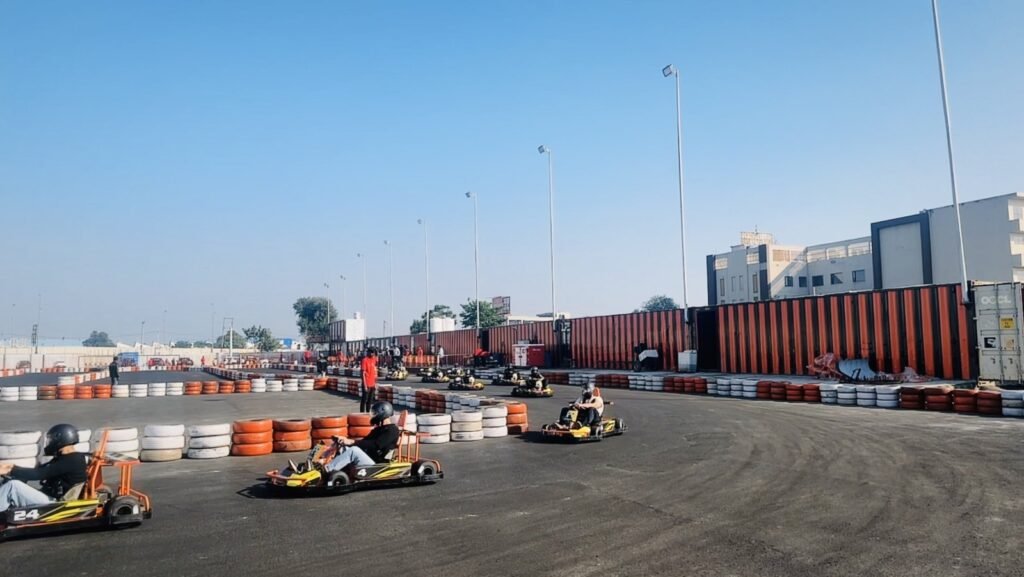
A lap is distance divided by speed. Take the 450-metre circuit at Sector 17/18. An average of 40 km/h is about 11 metres a second, so a lap takes roughly 40 seconds. Fifteen minutes is 900 seconds, and 900 divided by 40 is 22 laps.
Run the same sum on the 1,050-metre circuit at Sector 68, where a longer lap supports a higher average of around 50 km/h. That is 14 metres a second, a lap of about 72 seconds, and 900 divided by 72 is 12 laps. Same fifteen minutes, twenty-two laps against twelve, and neither circuit is short-changing anyone.
| Lap time | Laps in 15 minutes |
|---|---|
| 35 seconds | 25 |
| 40 seconds | 22 |
| 45 seconds | 20 |
| 50 seconds | 18 |
| 55 seconds | 16 |
| 60 seconds | 15 |
| 72 seconds | 12 |
| 80 seconds | 11 |
How many laps in 15 minutes go karting returns at each F9 circuit
The table below uses each circuit’s published length and a realistic average speed for a capable adult: lower on a tight, short lap, higher where the lap flows. These are arithmetic estimates, not posted lap times. A first-timer will be three to five seconds a lap slower than the figures shown, which is the difference between 22 laps and 18.
| Circuit | Length | Estimated lap | Laps in 15 min | Laps in 30 min |
|---|---|---|---|---|
| Track 01 — Sector 17/18, Link Road | 450 m | 40 s | 22 | 45 |
| Track 02 — Sector 59 | 850 m | 58 s | 15 | 31 |
| Track 06 — Dwarka Expressway | 900 m | 63 s | 14 | 28 |
| Track 04 — GT Karnal Road, Bhigan | 950 m | 66 s | 13 | 27 |
| Track 05 — Sector 68 | 1,050 m | 72 s | 12 | 25 |
| Track 03 — Baghpat | 1,250 m | 88 s | 10 | 20 |
Why other circuits publish a different number
A ticketing site in the UK sells fifteen minutes on a 350-metre indoor circuit as 20 laps, which is a 45-second lap on a tight loop. A South African price list puts fifteen minutes at roughly 30 laps, on a shorter indoor track again. Set against those, 22 laps on a 450-metre outdoor lap looks modest, and 10 laps at Baghpat looks worse still.
None of the three is wrong. A lap count without a lap length is not a measurement, it is a marketing number. Compare two venues by converting both to seconds per lap and the picture becomes honest in one line of arithmetic.
What eats the fifteen minutes
The arithmetic counts flying laps. A real session contains fewer, for four predictable reasons.
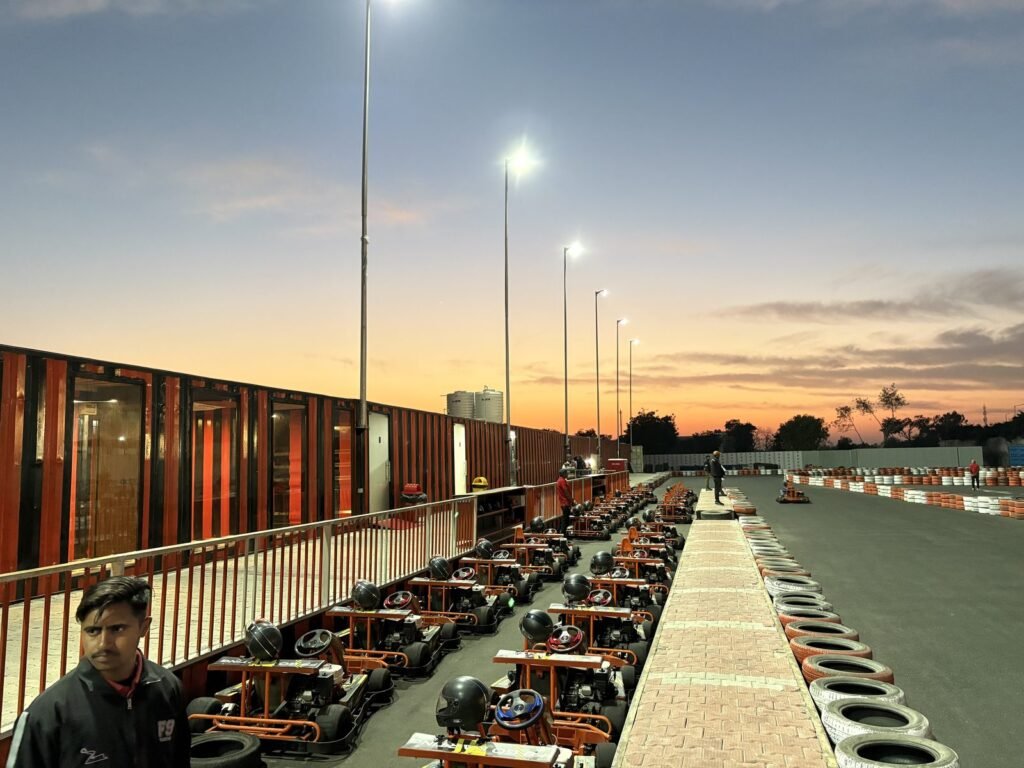
- The out-lap. Karts leave the pit lane together and the first lap is spent getting up to speed. On a 1,050-metre circuit that is over a minute you do not get back.
- Traffic. Catching a slower kart costs three to five seconds unless you can pass cleanly, and a compact 450-metre lap offers fewer places to do it.
- Yellow flags. One spin in the middle of a heat and the whole pack slows for a lap.
- The release. Twelve karts leaving together take half a lap to string out, and nobody is quick in that half lap.
Budget two to three laps below the sum. If you are booking a fifteen-minute heat at Sector 17/18, plan on 18 to 20 laps rather than 22, and treat anything above that as a good session.
Fifteen minutes against the packages the tracks sell
F9 sells laps on weekdays and minutes at weekends, so the two formats have to be converted before they can be compared. Track 01 on the Link Road is the cheapest circuit, which makes it the clearest example. Every rate below includes 18% GST.
| Track 01 — Sector 17/18 | Price | Unit price | Approximate laps |
|---|---|---|---|
| Weekday, 16 laps | ₹700 | ₹43.75 a lap | 16 |
| Weekday, 22 laps | ₹800 | ₹36.36 a lap | 22 |
| Weekday, 34 laps | ₹1,100 | ₹32.35 a lap | 34 |
| Weekend, 11 minutes | ₹800 | ₹72.73 a minute | about 16 |
| Weekend, 18 minutes | ₹1,200 | ₹66.67 a minute | about 27 |
| Weekend, 35 minutes | ₹2,100 | ₹60.00 a minute | about 52 |
Read down the right-hand columns and two things fall out. Laps get cheaper the more you buy, from ₹43.75 down to ₹32.35, and a weekend minute costs ₹60 to ₹73. That makes a fifteen-minute heat on a weekend more expensive per lap than the 34-lap weekday package, even though the headline price is smaller.
The fifteen-minute heat is sold at Track 02 in Sector 59 (weekend 15 or 30 minutes, ₹1,100 or ₹2,100), at Track 05 Sector 68 and Track 06 Dwarka Expressway (weekend 12, 15 or 30 minutes, ₹1,100, ₹1,200 or ₹2,200), and at Track 04 GT Karnal Road (weekend 12, 18 or 30 minutes, ₹900, ₹1,200 or ₹2,000). At ₹1,200 for fifteen minutes on the 1,050-metre circuit you are paying ₹80 a minute for twelve laps at most. It is the most expensive minute of karting on the rate card, which is worth knowing before you pick the shortest option to save money.
Ten, twenty and thirty minutes in laps
| Session | 450 m lap (40 s) | 850 m lap (58 s) | 1,050 m lap (72 s) | 1,250 m lap (88 s) |
|---|---|---|---|---|
| 10 minutes | 15 | 10 | 8 | 7 |
| 15 minutes | 22 | 15 | 12 | 10 |
| 20 minutes | 30 | 20 | 16 | 14 |
| 30 minutes | 45 | 31 | 25 | 20 |
Is fifteen minutes enough?
It depends what you want from it. On the 450-metre circuit, 20 laps is enough for the line to stick and for a lap time to come down by several seconds. On a 1,050-metre lap, the first four or five laps are a sighting run, which leaves seven good laps: enough to enjoy it, not enough to get quick.
For a group, fifteen minutes is about right as a first heat. Everyone gets a lap time, and you can decide on the day whether the group wants a second one. Thirty minutes in a single stint is a long time in a kart for anyone who has not driven before, because arms and wrists go before the fun does.
Booking on laps or on minutes
Two questions settle it on the phone: how long is the lap, and how many laps do I get? If a circuit answers only the second, ask for the length and divide it yourself. On a weekday, laps are usually the better buy; at weekends the time format is all that is offered, so buy the longer heat rather than two short ones, because the per-minute rate falls at every step up.
For the pricing rules behind the two formats, the guide to laps vs minutes sets out how each circuit sells a session, and the track length comparison explains why a long lap is not simply a short one stretched.
Which circuit to pick for lap count
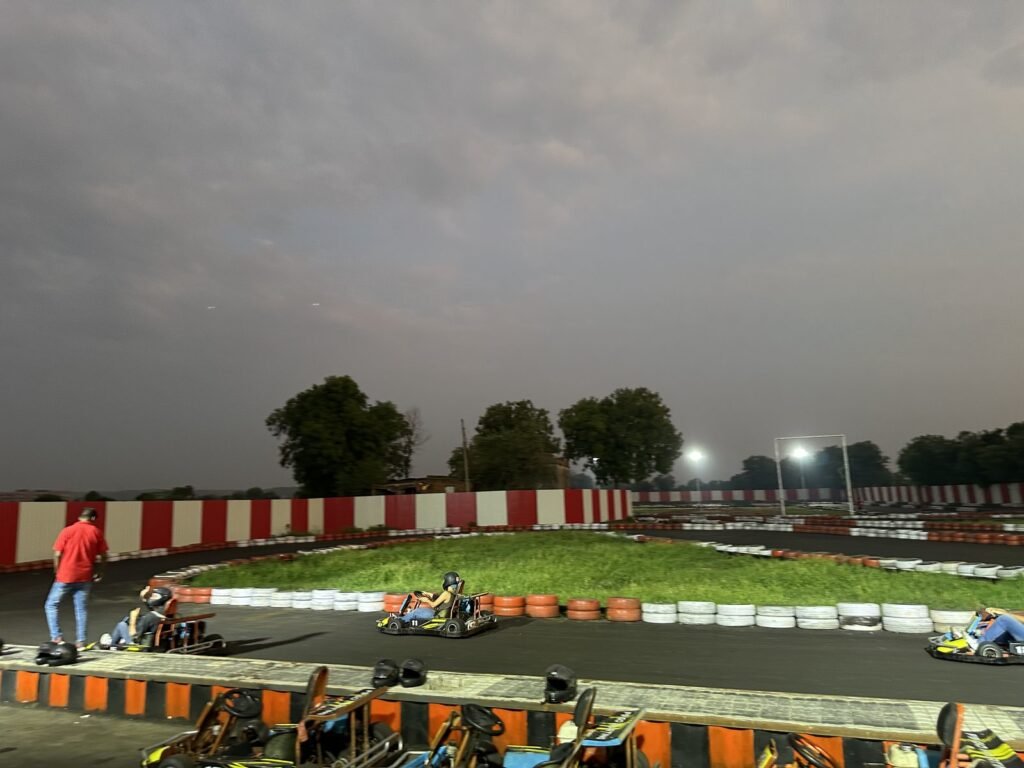
All six F9 circuits are outdoors, from 450 metres at Sector 17/18 to 1,250 metres at Baghpat. If lap count is what you care about, the 450-metre Link Road circuit returns the most laps per rupee and the 1,050-metre Sector 68 circuit returns the fewest. If lap quality is what you care about, the order reverses, because the long lap is the one where a driver can link corners and carry speed.
Either way, ask for the lap count on the package you are buying, not just the minutes. Call the circuit you are planning to visit, or get directions to Track 01 and check the lap length on the board before you book.
The same arithmetic explains why a short lap feels quicker than a long one: why do go karts feel fast counts braking points rather than kilometres.