Almost every parent planning a karting birthday hits the same question late in the process: what happens about karting birthday party food, and who brings the cake? The answer is less mysterious than it looks, but it depends on the venue. Some circuits run a kitchen, some allow outside catering, and some simply do not get involved. What matters is that you find out which one you are booking before you promise a cake to a nine-year-old.
This guide explains the three arrangements you will meet, how to time food around a driving session, what to ask on the call, and the cake logistics that go wrong most often. It is written for the person organising, not for the guests.
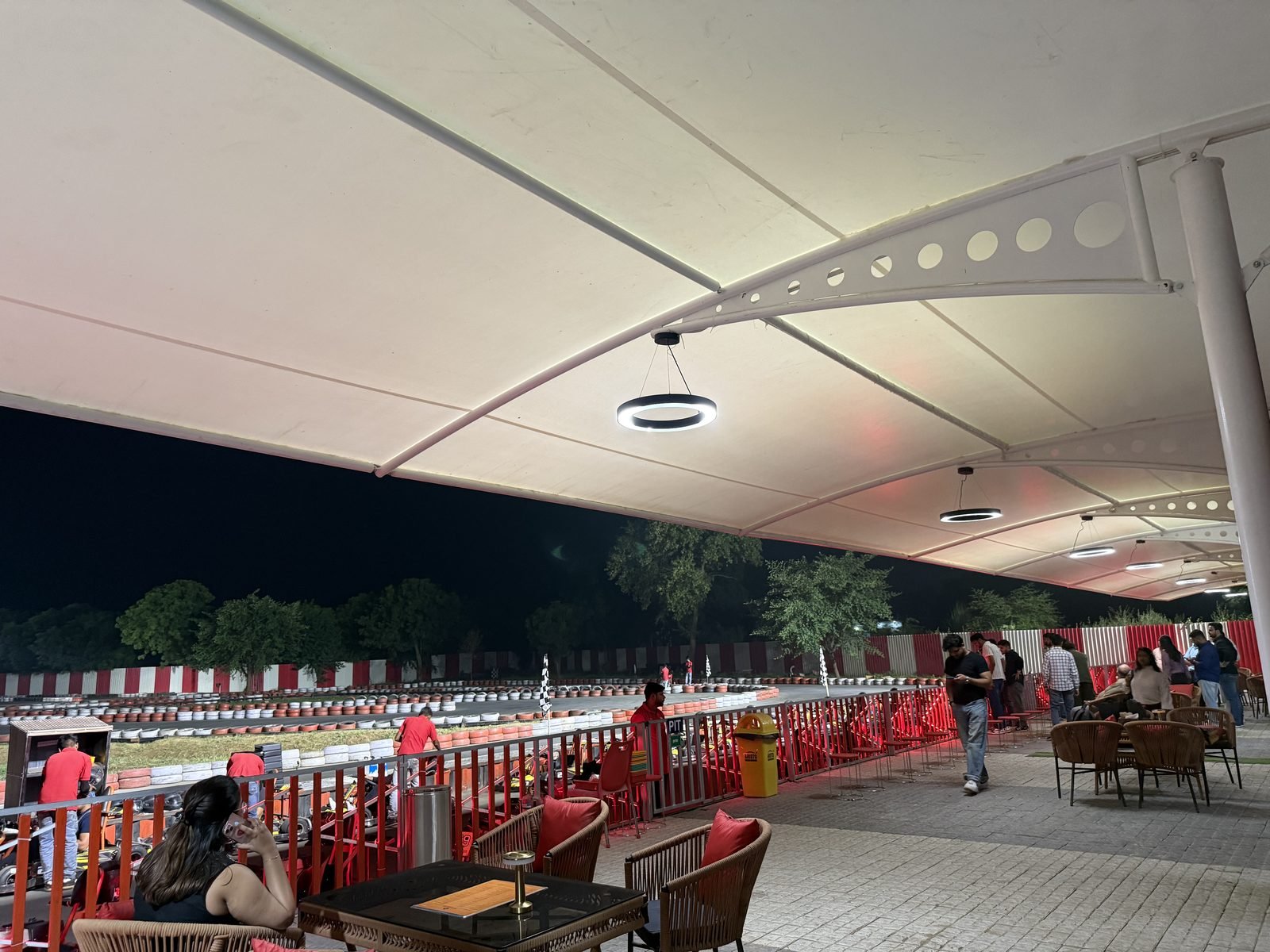
Karting birthday party food: the three arrangements
First, the venue-catered model. The circuit has a kitchen or a tie-up and sells you a per-head food package alongside the kart block. It is the simplest option, because one booking covers everything and nobody has to carry a cooler box across a car park.
Second, the outside-catering model. The circuit allows a caterer in, sometimes with a charge and sometimes with conditions about where the setup can go. This gives you control over the menu, which matters when half the guest list is vegetarian and one child has a nut allergy.
Third, the cake-only model, which is the most common in practice. The track provides the driving, a table and a place to cut a cake; the family brings the rest. It is the cheapest and the least fussy, and it works well for groups who plan to eat a proper meal somewhere else afterwards.
F9 does not publish a fixed food menu, because birthday packages are built around the group and priced for it. The birthday party page says plainly that package contents beyond track time are tailored to the booking. That sentence is the one to act on: ask what your specific package includes, in writing, before you send invitations.
Time the cake around the session, not during it
The single most useful planning decision is the order of events. Cakes do not work mid-session. Drivers are helmeted, engines are running and nobody wants icing on a steering wheel. The two workable patterns are cake before driving and cake after.
Cake before the session suits younger children. They arrive excited, the singing happens while everyone is still clean and dressed, and by the time they are in a kart the sugar has somewhere to go. The risk is a slow start: a child who has just eaten a slice does not want to be strapped into a harness straight away, so leave a gap.
Cake after the session suits teenagers and adults. The driving is the event, the cake is the debrief, and nobody is holding a plate while waiting for their heat. It also means the session runs on time, because nobody is late from the food table.
Therefore pick one and write it on the invitation. A party that tries to do both — snacks on arrival, cake mid-way, meal at the end — stretches a two-hour booking into four and leaves the track waiting.
What to ask before you order anything
- Is outside food allowed, and is there a charge? Ask about the cake specifically, since some venues waive their rule for a birthday cake and nothing else.
- Is there a covered place to eat? Outdoor circuits are outdoor circuits. If the plan depends on a table, confirm there is one and that it is under cover.
- Can we bring our own plates, napkins and a knife? Small thing, frequent failure. Venues rarely refuse, but nobody stocks for your group.
- Is there a fridge for the cake? A cream cake in a Gurgaon afternoon does not survive a two-hour session in a car.
- What time should the food arrive relative to the session? Deliveries that land at the wrong moment are the most common cause of a rushed party.
Get those five answers and the rest of the plan writes itself. For the wider timeline — invitations, numbers, deposits — the 30-day birthday checklist covers the sequence from a month out.
Feeding a mixed group
Karting parties are rarely one age group. A ten-year-old’s party has parents, siblings and grandparents standing at the barrier. That changes the food plan in two ways. You need more food than the number of drivers, and you need it to be easy to eat standing up.
The practical answer is finger food sized for one hand: sandwiches, wraps, samosas, fruit, and something cold to drink. Anything that needs a knife and fork, a flat surface and ten uninterrupted minutes is the wrong choice at a circuit. Kids eat standing, then run back to watch the next heat.
Dietary spread is worth planning for explicitly. A simple split — one vegetarian savoury, one non-vegetarian, one fruit option, one sweet — covers most groups without a menu committee. Label anything with nuts. If a guest has a serious allergy, tell the track when you book, because that is the venue’s decision to make, not yours.
Cake logistics that go wrong
Three failures account for most birthday cake problems at a circuit. The first is transport: a tall cake in a warm car arrives leaning. A flat, sheet-style cake travels better and cuts faster.
The second is candles outdoors. Wind is a real problem on an open track, so bring a lighter rather than matches and consider a candle holder with a shield. The third is timing the cut: cutting a cake for twenty people takes longer than people expect, so start five minutes before you think you need to.
Finally, pack for the aftermath. A bag for plates, a cloth for the table, a box for leftovers. None of it is glamorous, and all of it is the difference between a smooth party and a parent scrubbing icing off a picnic bench.
Budget: food is a separate line
The kart block is priced per kart, not per head, and it already includes 18% GST. At Sector 59, six karts for thirty minutes is ₹11,500 and twenty karts for an hour is ₹51,500. Food sits outside that number entirely, which is why a party budget should be built in two columns rather than one.
Then work out the per-head figure: kart block divided by drivers, plus food divided by everyone present. Those are different denominators, and confusing them is how a party ends up over budget. Sector 59 is the usual choice for larger birthdays because it takes up to twenty karts; the Sector 59 track page explains why the venue is built for groups.
A running order that works
For an afternoon party of twelve drivers, this sequence holds up. Guests arrive thirty minutes before the slot and eat nothing heavy. The group is briefed and drives. When the session ends, everyone is back in normal clothes, the table is set and the cake comes out. Then food, then the slower business of saying goodbye.
If you are doing cake before driving instead, reverse it: cake first, then a fifteen-minute gap, then the briefing. Either order works as long as the food and the driving never overlap.
Questions about karting party food
Is food included in the party package? Not as a published menu. Food is arranged as part of the package you agree when you book, so ask what your quote covers.
Can we bring our own cake? Ask the track directly. It is a common request, and the answer depends on the venue and the date.
Do parents need to pay for food? Only if you are feeding them. Spectators do not need a kart, and they do not automatically need a plate.
What if it rains? Outdoor circuits get wet, and a food plan without cover is the part that fails. Ask about a covered area at the same time as you ask about the cake.
The most reliable route is a short call. Say the date, the number of drivers, whether you want food on site and whether you are bringing a cake, and let the track price it. Contact F9 Go Karting with those four details. For directions, the Sector 59 map link takes you to the group venue.