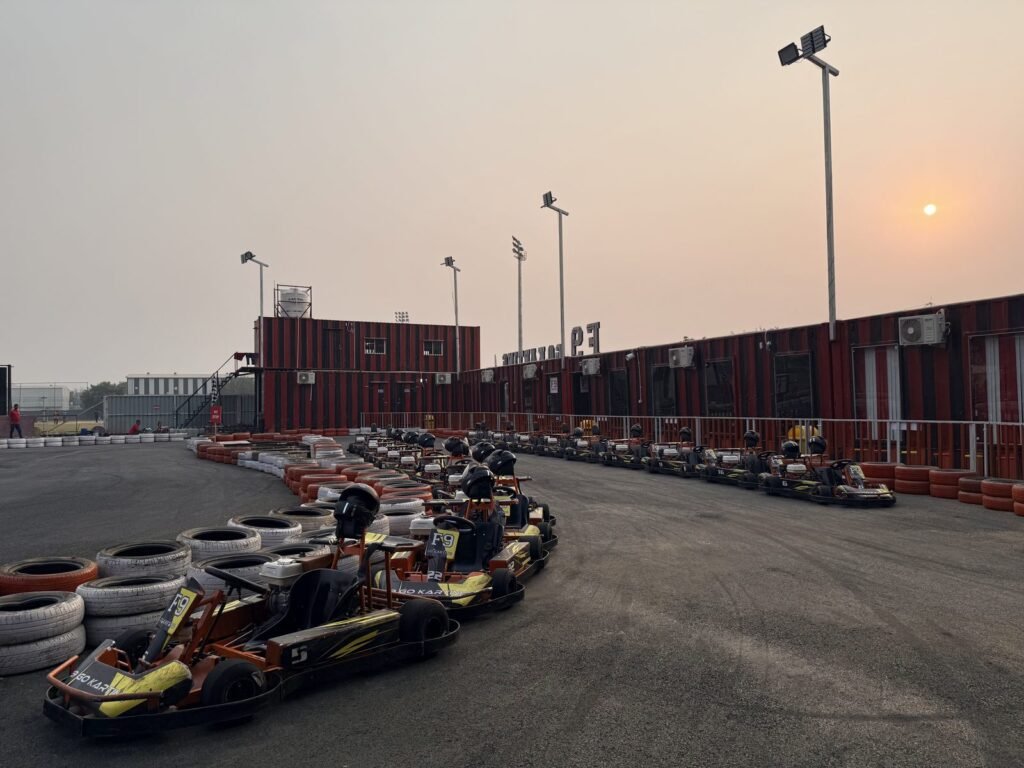
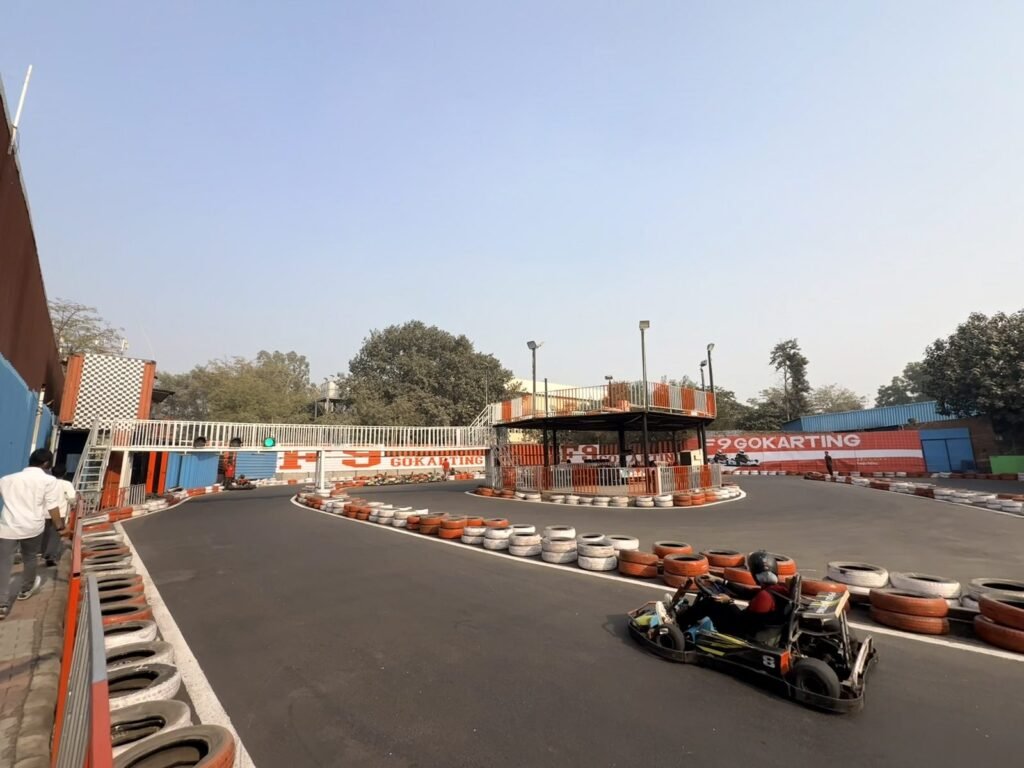
Go karting in cold weather is not a smaller version of go karting in summer. The engine likes the cold and the tyres do not, and between those two facts sits everything that changes in a session: how the first three laps feel, how early you need to brake, why the kart in front of you will not turn in where it usually does, and why the lap you set in January is not the lap you set in April.
Below is what actually happens on an outdoor circuit in Delhi NCR from November to February, and what you can do about it in a rental kart you did not build yourself.
Cold air gives the engine more, not less
Cold air is dense air. A dense charge holds more oxygen per stroke, so a kart engine makes a little more power at 9°C than it does at 39°C. Drivers who race through a winter say the same thing every year — the kart pulls harder off the corner and the main straight feels shorter. That part of a cold session is genuinely better.
The catch is that the same air temperature which suits the engine is the wrong temperature for the four contact patches holding you on the asphalt.
The tyres are the whole story
Tyres make grip by getting hot. Heat softens the rubber, the rubber keys into the surface, and the kart holds the line you asked for. On a cold surface that never happens on schedule: the tyre takes two or three laps to reach a working temperature, and on a grey winter morning it may never get there at all. The kart then feels nervous, the front washes wide and the rear lets go the moment you squeeze the throttle.
There is a second effect that catches people out. The fast line around any circuit is the line where other karts have laid rubber down, because rubber on rubber grips. When the surface is cold and damp, that same laid-down rubber becomes the slickest strip on the circuit. The place you would normally aim for is the place to avoid, and drivers who have never driven in the cold spend the whole session wondering why the kart will not turn in.
What the first three laps are really for
A cold session has a fixed shape. Once you know it, you stop wasting laps.
- Lap one is a write-off. The brakes are cold, the tyres are cold and your hands have not learned the steering weight yet. Treat it as a sighting lap.
- Lap two is where you find out how much grip exists. Load the front tyres gently on entry, then add throttle only once the kart is straight. If the rear steps out, you are already past what the tyre can give.
- Lap three is the first lap worth timing. From here, smoothness beats bravery. The driver who slides least is the fastest driver on a cold circuit, every time.
Does the cold make you slower? Yes, and it does not matter
A cold lap is a slower lap than the same corner in April. Less grip means less speed carried into the corner, and no amount of commitment fixes that. What the cold does not change is the race in front of you: everyone in that session is on the same cold asphalt with the same cold tyres, so the gap between you and your friends is still decided by who slides least.
Judge a cold session against the people in it, not against a stopwatch number from a summer visit. If you want a benchmark you can compare across seasons, use position rather than lap time.
You cannot change the kart, so change what you buy
On a rental kart the setup is not yours to tune. You run the tyre pressures and the engine setting the circuit runs. That removes every mechanical cold-weather trick — no jetting changes, no softer axle, no radiator tape — and leaves one decision that actually moves the needle: how long you book.
Cold minutes are worth less at the start of a session than at the end, because the first part is warm-up. A short block is mostly warm-up. The figures below are from each circuit’s own card and already include 18% GST.
| Circuit | Weekend sessions | Price per driver | Cost per minute |
|---|---|---|---|
| Sector 17/18 Link Road — 450 m | 11 min / 18 min / 35 min | ₹800 / ₹1,200 / ₹2,100 | ₹72.73 / ₹66.67 / ₹60.00 |
| Sector 59 — 850 m | 15 min / 30 min | ₹1,100 / ₹2,100 | ₹73.33 / ₹70.00 |
| GT Karnal Road — 950 m | 12 min / 18 min / 30 min | ₹900 / ₹1,200 / ₹2,000 | ₹75.00 / ₹66.67 / ₹66.67 |
| Sector 68 — 1,050 m | 12 min / 15 min / 30 min | ₹1,100 / ₹1,200 / ₹2,200 | ₹91.67 / ₹80.00 / ₹73.33 |
| Dwarka Expressway — 900 m | 12 min / 15 min / 30 min | ₹1,100 / ₹1,200 / ₹2,200 | ₹91.67 / ₹80.00 / ₹73.33 |
Two things fall out of that table. First, the long session is always the cheapest minute on the card: at Link Road, 35 minutes costs ₹60 a minute against ₹72.73 for 11 minutes. Second, in cold weather the long session is worth more than the discount suggests, because it is the only block with enough room for a real warm-up and then some real laps.
Weekdays work differently. Every circuit sells weekday sessions in laps rather than minutes — at Link Road it is 16, 22 and 34 laps for ₹700, ₹800 and ₹1,100, and at Sector 59, GT Karnal Road, Sector 68 and Dwarka Expressway it is 10 and 15 laps or 12 and 18 laps for ₹900 and ₹1,100. Cold laps are slower laps, so a fixed number of laps takes longer in clock time than the same purchase in May. If you are booking on a weekday, buy laps and accept that the circuit will give you more minutes than the lap count implies.
How to drive go karting in cold weather
Driving a cold circuit is a discipline rather than a technique. The kart will not do what it does in summer, so stop asking it to.
- Brake earlier and lighter. A cold tyre locks sooner, and a locked tyre costs you the corner and possibly a flat spot.
- Trail the brake to the apex. Keep a little pressure on as you turn in, then release progressively. It keeps the front loaded while the tyre is still coming up to temperature.
- Take a late apex. Waiting an extra metre to turn means the kart is straighter when you get back on the power, and straighter means faster.
- Squeeze the throttle. On a cold track a stamp on the pedal spins the rear and costs more time than the corner did.
- Do not fight the slide. A sliding kart is a slow kart. If the rear steps out, unwind the steering and wait; correcting hard makes it worse.
What to wear
You will be standing still between runs, and that is when the cold really lands. Wear close-fitting layers you can keep on inside a race suit, and keep everything tucked in — a loose scarf, a dupatta or a dangling jacket cord has no business near a kart. Thin gloves under whatever hand protection the circuit provides keep your fingers working, which matters more than it sounds: cold hands brake late and grip the wheel too tightly.
Fog, dew and the one thing that stops a session
Rain is rarely the problem on an NCR winter circuit. Visibility is. Thick fog is the one condition that genuinely stops karts going out, because a driver who cannot see the next corner cannot safely share a circuit with other karts. Dew is the second: a surface that is wet at dawn is at its slickest, and it dries as the day goes on.
So if the forecast looks bad, call the circuit before you leave rather than after you arrive. The two most central circuits are Sector 17/18 Link Road on 098115 48655 and Sector 59 on 9319820090.
A cold-day checklist
- Book the longest block you can afford, not the cheapest.
- Drive later in the day if the choice is yours; the surface is warmer than it is at first light.
- Budget two laps of warm-up before you judge your own pace.
- Wear layers, and nothing loose around the neck.
- Keep a thin pair of gloves in your pocket.
- Call ahead if the fog is thick.
- Read the first-time karting guide if this is your first session.
Where to drive it
Cold weather rewards the longer laps, because a longer lap has fewer corners per minute and corners are where cold grip bites. The 1,050 m Sector 68 circuit and the 900 m Dwarka Expressway circuit both sell a 30-minute weekend block, and the 950 m GT Karnal Road circuit is the best value on the network in cold weather at ₹66.67 a minute for 30 minutes.
If you want every length, card and kart count in one place, start at the tracks page. If you are choosing between a short slot and a long one, read 30 minutes vs 15 minutes before you book — in winter the answer tilts towards the longer block.

Booking a cold session
Tell the circuit the date, the number of drivers and which block you want, and ask what the surface is doing that morning. A two-minute call before you drive out is cheaper than a wasted trip. Prices above are per driver and include 18% GST; anything the circuit adds goes on the bill as applicable.
Send the date and driver count through the contact page, or call the circuit directly. If you are heading to GT Karnal Road, save the directions before you set out — the circuit sits off the highway at Bhigan village near Ganaur.